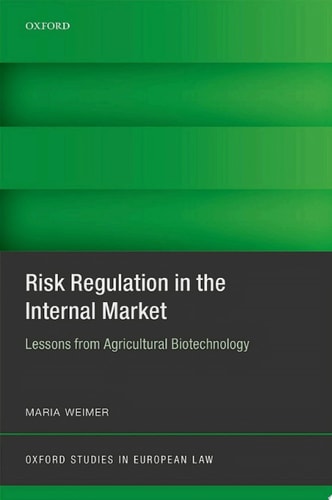
Risk Regulation in the Internal Market: Lessons from Agricultural Biotechnology
0
0
As an Amazon Associate and affiliate partner, Menrva Books earns from qualifying purchases. Learn more
Author Description
This book offers a topical inquiry into the legal and political limits of EU regulation in the field of risk and new technologies surrounded by techno-scientific complexity, uncertainty, and societal contestation. It uses agricultural biotechnology as a paradigmatic example to illustrate the complex intertwinement between environmental, public health, economic and social concerns in risk regulation. Weimer analyses the drawbacks of the EU approach to agricultural biotechnology showing that its reductionism, i.e. the narrow understanding of GMO risks as well as the exclusion of broader societal concerns related to environmental and social sustainability, has undermined both the legitimacy and effectiveness of EU regulation in this area. Resistance to this approach however has also triggered legal innovations prompting us to re-think EU internal market law, including the way in which it manages the tensions between unity and diversity, and between social and economic concerns. This text offers fresh and original insights into how far the EU can go in harmonizing regulatory approaches to risk. At the same time, it proposes new ways of re-thinking EU risk regulation to make it more responsive to different perspectives on risk and technology. A unique feature of this book is that it contributes to various strains of scholarship including risk regulation, internal market law, public administration, and studies of governance and regulation, as well as connecting these themes to broader debates about the legitimacy of European integration and new ways of differentiated integration. As a result it assists in re-imagining the EU internal market and its regulation as a site of diversity.
Menrva's Summary
THE THESIS
This book investigates the legal and political limitations of European Union risk regulation when applied to complex, contested technologies like agricultural biotechnology. Author Maria Weimer, a scholar in European law and governance, examines how the EU's narrow, reductionist approach to GMO risk assessment has compromised regulatory legitimacy. She argues that by excluding broader societal, environmental, and economic concerns, the current framework fails to address the realities of modern techno-scientific uncertainty.
THE SCOPE MAP
What You Will Find
- Analysis of EU internal market law and its management of unity versus diversity.
- Examination of the regulatory failures regarding GMOs and agricultural biotechnology.
- Theoretical frameworks for re-imagining EU governance to be more responsive to diverse societal perspectives.
Scope Limits
- The text focuses primarily on the EU legal framework and does not provide a comprehensive global comparative analysis of biotechnology regulation.
- It does not offer a technical scientific manual for GMO safety but rather a legal and administrative critique of the regulatory process.
THE AUTHORITY PERSPECTIVE
Legal scholars and policy experts recognize this work as a significant contribution to the study of European integration and administrative law. Readers frequently note the academic density of the prose, which is best suited for those already familiar with the intricacies of EU internal market regulation.
Page Count:
296
Publication Date:
2019-01-01
Publisher:
OUP Oxford
ISBN-10:
0191047198
ISBN-13:
9780191047190
Public Policy
Law
European Union
Governance
Professional Career & Trade
Community Tags
Similar Books