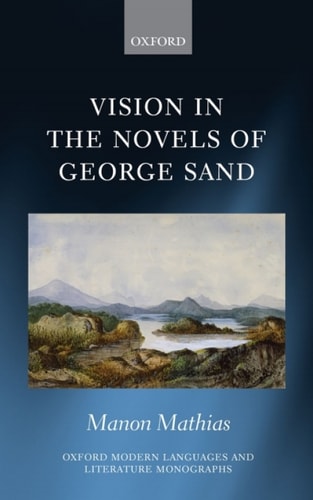
Vision in the Novels of George Sand
0
0
As an Amazon Associate and affiliate partner, Menrva Books earns from qualifying purchases. Learn more
Author Description
The first study of George Sand and vision, this book considers the pull between the visual and the visionary in nineteenth-century France through an examination of Sand's novels. With an extensive corpus ranging from Sand's early texts through to her later, less familiar works, it repositions Sand's œuvre alongside that of the major realist authors and demonstrates her distinctive understanding of the novel as a combination of the concrete and the abstract. By studying Sand's engagement with visual models associated with realism-the mirror, the model of painting, and the scientific gaze-this book proposes a more sustained dialogue between Sand's work and realism than has hitherto been acknowledged, but argues that Sand radically reworks these models to depict a dynamic, mysterious and ever-changing world. Whereas Sand has been read as an author bypassing reality in favour of the ideal, this study shows that she is committed to physical observation, but that she consistently ties this process with the conceptual and the visionary. The book breaks new ground in particular by examining Sand's literary engagement with the visual arts, and it also offers the first sustained consideration of Sand as a scientific writer. By examining Sand's œuvre from the perspective of vision, this study not only reassesses Sand's writing practice, but also rethinks the relations between the visual and the novel in this period. More specifically, it argues that Sand's work challenges our means of theorizing these relations. In her rejection of binaries and her syncretic understanding of vision, Sand breaks conventional categories and writes novels that are at once realist, visionary, mystical and scientific.
Menrva's Summary
THE THESIS
This study investigates how George Sand integrates visual observation with visionary concepts to challenge traditional definitions of nineteenth-century realism. Manon Mathias, a scholar of French literature, utilizes a comprehensive analysis of Sand's early and late novels to argue that the author's work functions as a synthesis of the concrete and the abstract. By examining Sand's engagement with the mirror, painting, and the scientific gaze, the book posits that her writing offers a more complex dialogue with realism than previously recognized.
THE SCOPE MAP
What You Will Find
- Analysis of Sand's engagement with visual models including mirrors and painting
- Examination of Sand's role as a scientific writer
- Comparative study of Sand's work against major realist authors of the nineteenth century
- Theoretical framework for understanding the intersection of the visual and the novel
Scope Limits
- The study focuses primarily on Sand's novels rather than her non-fictional essays or correspondence
- It does not provide a comprehensive biography of the author, focusing instead on literary analysis
THE AUTHORITY PERSPECTIVE
Scholars and critics identify this work as a significant contribution to Sand studies, particularly for its focus on her scientific and visual sensibilities. Readers frequently note the academic density of the prose, which is intended for researchers and students of nineteenth-century French literature.
Page Count:
192
Publication Date:
2015-01-01
Publisher:
OUP Oxford
ISBN-10:
0191054321
ISBN-13:
9780191054327
Nineteenth century
Literary theory
Criticism history
Literary Criticism
Visual Culture
English
French literature
English & College Success
Academic
Community Tags
Similar Books