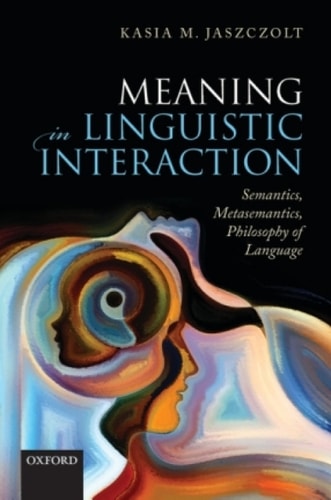
Meaning in Linguistic Interaction: Semantics, Metasemantics, Philosophy of Language
0
0
As an Amazon Associate and affiliate partner, Menrva Books earns from qualifying purchases. Learn more
Author Description
This book offers a semantic and metasemantic inquiry into the representation of meaning in linguistic interaction. Kasia Jaszczolt's view represents the most radical stance on meaning to be found in the contextualist tradition and thereby the most radical take on the semantics/pragmatics boundary. It allows for the selection of the cognitively plausible object of enquiry without being constrained by such distinctions as what is said/what is implicated or what is linguistic and what is extralinguistic. She argues that this is the only promising stance on meaning. The analysis transcends the traditional distinctions drawn, and traditional questions posed, in post-Gricean pragmatics and philosophy of language. It heavily relies on the dynamic construction of meaning in discourse, using truth conditions as a tool but at the same time conforming to pragmatic compositionality? whereby aspects of meaning that enter this composition have very different provenance. Meaning in Linguistic Interaction builds on the author's earlier work on Default Semantics and adds new arguments in favour of radical contextualism as well as novel applications, focusing on the role of salience, the flexibility of word meaning, the literal/nonliteral distinction, and the dynamic nature of a character, as well as offering an entirely new perspective on the indexical/nonindexical distinction. It contains a state-of-the-art discussion of the semantics/pragmatics boundary disputes, focusing on varieties of semantic minimalism and contextualism and on the limitations of an indexicalism. Jaszczolt's work is illustrated with examples from a variety of languages and offers some formal representations of meaning in the metalanguage of Default Semantics.
Menrva's Summary
THE THESIS
This book investigates how meaning is represented and constructed within linguistic interaction, specifically challenging traditional boundaries between semantics and pragmatics. Kasia M. Jaszczolt, a prominent scholar in the field, utilizes her framework of Default Semantics to argue for a radical contextualist approach. By moving beyond conventional distinctions such as literal versus non-literal meaning, she proposes a model where meaning is dynamically constructed through discourse and cognitive salience.
THE SCOPE MAP
What You Will Find
- A comprehensive analysis of the semantics/pragmatics boundary.
- Theoretical exploration of radical contextualism versus semantic minimalism.
- Formal representations of meaning within the metalanguage of Default Semantics.
- Discussions on indexicality, word meaning flexibility, and the role of salience in communication.
Scope Limits
- The text does not provide a general introduction to linguistics for absolute beginners.
- It does not cover historical linguistics or sociolinguistic variations outside the scope of semantic theory.
THE AUTHORITY PERSPECTIVE
Experts recognize this work as a significant contribution to the contextualist tradition, often noting the high level of academic density and technical rigor required to engage with the arguments. It is frequently cited as a primary text for researchers and graduate students focusing on the intersection of philosophy of language and pragmatic theory.
Page Count:
240
Publication Date:
2016-01-01
Publisher:
OUP Oxford
ISBN-10:
0191068985
ISBN-13:
9780191068980
Linguistics
English
Pragmatics
Philosophy of
Semantics
English & College Success
Community Tags
Similar Books