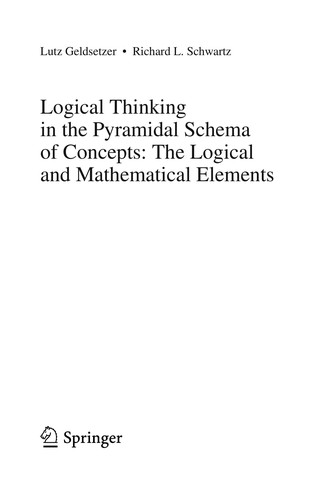
Logical Thinking in the Pyramidal Schema of Concepts: The Logical and Mathematical Elements
0
0
As an Amazon Associate and affiliate partner, Menrva Books earns from qualifying purchases. Learn more
Author Description
This new volume on logic follows a recognizable format that deals in turn with the topics of mathematical logic, moving from concepts, via definitions and inferences, to theories and axioms. However, this fresh work offers a key innovation in its ‘pyramidal’ graph system for the logical formalization of all these items. The author has developed this new methodology on the basis of original research, traditional logical instruments such as Porphyrian trees, and modern concepts of classification, in which pyramids are the central organizing concept. The pyramidal schema enables both the content of concepts and the relations between the concept positions in the pyramid to be read off from the graph. Logical connectors are analyzed in terms of the direction in which they connect within the pyramid. Additionally, the author shows that logical connectors are of fundamentally different types: only one sort generates propositions with truth values, while the other yields conceptual expressions or complex concepts. On this basis, strong arguments are developed against adopting the non-discriminating connector definitions implicit in Wittgensteinian truth-value tables. Special consideration is given to mathematical connectors so as to illuminate the formation of concepts in the natural sciences. To show what the pyramidal method can contribute to science, a pyramid of the number concepts prevalent in mathematics is constructed. The book also counters the logical dogma of ‘false’ contradictory propositions and sheds new light on the logical characteristics of probable propositions, as well as on syllogistic and other inferences.
Menrva's Summary
THE THESIS
This volume introduces a novel 'pyramidal' graph system for the logical formalization of concepts, definitions, inferences, theories, and axioms. The author, Lutz Geldsetzer, a researcher in logic, presents a methodology developed from original research, traditional logic instruments, and modern classification concepts. This pyramidal schema allows for the graphical representation of concept content and inter-concept relations, with logical connectors analyzed based on their directional connections within the pyramid. The work distinguishes between connectors that generate propositions with truth values and those that yield conceptual expressions, challenging established definitions like Wittgensteinian truth-value tables.
THE SCOPE MAP
- A novel 'pyramidal' graph system for logical formalization.
- Analysis of logical connectors based on their directional roles within the pyramid.
- Distinction between connectors generating truth-valued propositions and those yielding conceptual expressions.
- Critique of Wittgensteinian truth-value tables.
- Application of mathematical connectors to illuminate concept formation in natural sciences.
- Construction of a pyramidal schema for mathematical number concepts.
- Discussion on the logical characteristics of probable propositions and syllogistic inferences.
THE AUTHORITY PERSPECTIVE
The book presents a unique methodological innovation with its pyramidal graph system for formalizing logical elements. Its approach to analyzing logical connectors and distinguishing between different types offers a novel perspective that challenges existing frameworks. The detailed construction of a pyramidal schema for mathematical concepts and its application to natural sciences suggest a rigorous and specialized academic contribution. The work aims to shed new light on fundamental logical characteristics, including probable propositions and inferences.
Page Count:
137
Publication Date:
2013-01-01
ISBN-10:
9400753012
ISBN-13:
9789400753013
Philosophy
Science & Technology
Science
Non-Fiction
Logic
Mathematics
Formal Logic
Conceptual Analysis
Community Tags
Similar Books