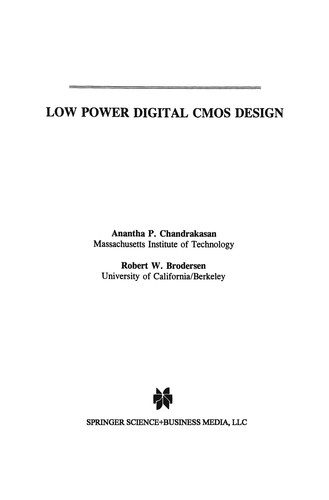
Low Power Digital CMOS Design
0
0
As an Amazon Associate and affiliate partner, Menrva Books earns from qualifying purchases. Learn more
Author Description
Power consumption has become a major design consideration for battery-operated, portable systems as well as high-performance, desktop systems. Strict limitations on power dissipation must be met by the designer while still meeting ever higher computational requirements. A comprehensive approach is thus required at all levels of system design, ranging from algorithms and architectures to the logic styles and the underlying technology. Potentially one of the most important techniques involves combining architecture optimization with voltage scaling, allowing a trade-off between silicon area and low-power operation. Architectural optimization enables supply voltages of the order of 1 V using standard CMOS technology. Several techniques can also be used to minimize the switched capacitance, including representation, optimizing signal correlations, minimizing spurious transitions, optimizing sequencing of operations, activity-driven power down, etc. The high- efficiency of DC-DC converter circuitry required for efficient, low-voltage and low-current level operation is described by Stratakos, Sullivan and Sanders. The application of various low-power techniques to a chip set for multimedia applications shows that orders-of-magnitude reduction in power consumption is possible. The book also features an analysis by Professor Meindl of the fundamental limits of power consumption achievable at all levels of the design hierarchy. Svensson, of ISI, describes emerging adiabatic switching techniques that can break the CV2f barrier and reduce the energy per computation at a fixed voltage. Srivastava, of AT&T, presents the application of aggressive shut-down techniques to microprocessor applications.
Menrva's Summary
THE THESIS
This book investigates the critical challenge of minimizing power consumption in digital CMOS design while maintaining high computational performance. The authors address this by presenting a comprehensive approach that spans algorithms, architectures, logic styles, and technology. Key techniques discussed include combining architectural optimization with voltage scaling, minimizing switched capacitance through various methods, and the application of aggressive shut-down strategies. The book also explores the fundamental limits of power consumption and emerging adiabatic switching techniques.
THE SCOPE MAP
- Techniques for combining architecture optimization with voltage scaling for low-power operation.
- Methods to minimize switched capacitance, including representation, signal correlations, and spurious transitions.
- Application of low-power techniques to chip sets for multimedia applications.
- Analysis of fundamental limits of power consumption at all levels of the design hierarchy.
- Description of emerging adiabatic switching techniques.
- Application of aggressive shut-down techniques to microprocessor applications.
- Discussion of DC-DC converter circuitry for efficient, low-voltage operation.
THE AUTHORITY PERSPECTIVE
This book is regarded as a foundational text in low-power digital CMOS design, offering a comprehensive overview of techniques crucial for modern electronic systems. Its detailed exploration of architectural optimization, voltage scaling, and capacitance minimization provides engineers with practical strategies. The inclusion of analysis on fundamental limits and emerging technologies like adiabatic switching positions it as a valuable resource for both current design challenges and future advancements. The application examples, particularly for multimedia and microprocessor systems, demonstrate the significant power reduction potential achievable.
Page Count:
409
Publication Date:
1995-01-01
ISBN-10:
1461359848
ISBN-13:
9781461359845
Non-Fiction
Science
Computer Engineering
Digital Design
Community Tags
Similar Books