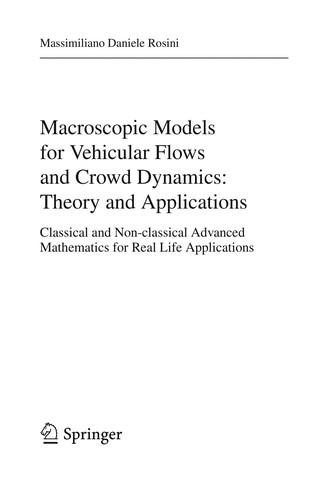
Macroscopic Models for Vehicular Flows and Crowd Dynamics: Theory and Applications
0
0
As an Amazon Associate and affiliate partner, Menrva Books earns from qualifying purchases. Learn more
Author Description
This monograph presents a systematic treatment of the theory for hyperbolic conservation laws and their applications to vehicular traffics and crowd dynamics. In the first part of the book, the author presents very basic considerations and gradually introduces the mathematical tools necessary to describe and understand the mathematical models developed in the following parts focusing on vehicular and pedestrian traffic. The book is a self-contained valuable resource for advanced courses in mathematical modeling, physics and civil engineering. A number of examples and figures facilitate a better understanding of the underlying concepts and motivations for the students. Important new techniques are presented, in particular the wave front tracking algorithm, the operator splitting approach, the non-classical theory of conservation laws and the constrained problems. This book is the first to present a comprehensive account of these fundamental new mathematical advances.
Menrva's Summary
THE THESIS
This monograph systematically treats the theory of hyperbolic conservation laws and their applications to vehicular traffic and crowd dynamics. The author begins with fundamental considerations, gradually introducing the mathematical tools required to understand the models presented for vehicular and pedestrian traffic. This self-contained resource is valuable for advanced courses in mathematical modeling, physics, and civil engineering, utilizing examples and figures to clarify concepts.
THE SCOPE MAP
- Mathematical tools for describing and understanding traffic and crowd dynamics models.
- Applications of hyperbolic conservation laws to vehicular traffic.
- Applications of hyperbolic conservation laws to crowd dynamics.
- The wave front tracking algorithm.
- The operator splitting approach.
- The non-classical theory of conservation laws.
- Constrained problems in mathematical modeling.
THE AUTHORITY PERSPECTIVE
This book is presented as a comprehensive account of fundamental new mathematical advances in the modeling of vehicular and crowd dynamics. The author's systematic treatment and gradual introduction of concepts, supported by examples and figures, aim to make it a valuable resource for advanced students and professionals in mathematical modeling, physics, and civil engineering. The inclusion of specific techniques like the wave front tracking algorithm and operator splitting suggests a focus on rigorous mathematical methods.
Page Count:
242
Publication Date:
2013-01-01
ISBN-10:
331900154X
ISBN-13:
9783319001548
Art
Science
Non-Fiction
Civil Engineering
Mathematical Modeling
Traffic engineering
Applied Mathematics
Physics
Community Tags
Similar Books