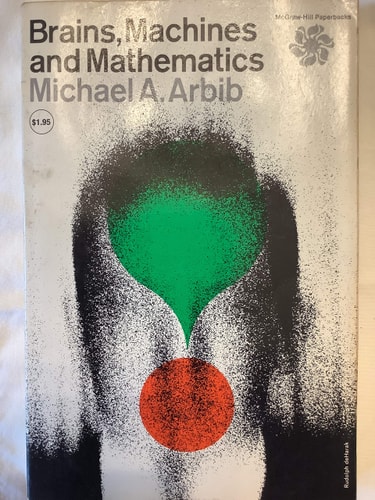
Brains, Machines, and Mathematics.
0
0
As an Amazon Associate and affiliate partner, Menrva Books earns from qualifying purchases. Learn more
Author Description
Traces the relationship between the development of computing machines and our knowledge of brain functioning, and introduces corresponding mathematical models designed to describe this relationship. Begins with a historical overview tracing the rise of cybernetics to the current interchange of ideas between AI and brain theory. Subsequent chapters introduce neural sets and finite automata, the crucial cybernetic concepts of feedback and realization, pattern recognition networks, "semi-neural" learning networks, capabilities of Turing machines and automata which construct as well as compute. The final chapter presents two accessible proofs of Gödel's Incompleteness Theorem.
Menrva's Summary
THE THESIS
This book investigates the historical and theoretical intersection between the evolution of computing machines and the biological mechanisms of the human brain. Author Michael A. Arbib, a prominent figure in brain theory and artificial intelligence, utilizes a framework of cybernetics to bridge the gap between neurobiology and computational logic. He argues that mathematical modeling provides the necessary language to formalize the relationship between neural activity and machine intelligence.
THE SCOPE MAP
What You Will Find
- Historical overview of cybernetics and the development of AI
- Mathematical models including neural sets and finite automata
- Analysis of feedback loops and realization in cybernetic systems
- Exploration of pattern recognition and learning networks
- Proofs of Gödel's Incompleteness Theorem
Scope Limits
- The text does not provide a comprehensive history of modern deep learning or contemporary neural network architectures developed after the book's initial publication.
- It does not focus on the philosophical implications of consciousness, remaining strictly within the bounds of mathematical and cybernetic modeling.
THE AUTHORITY PERSPECTIVE
Experts recognize this work as a foundational text that successfully synthesizes early cybernetic theory with biological brain models. Readers frequently note the academic density of the prose, which requires a solid background in mathematics to fully grasp the formal proofs and automata theory presented.
Page Count:
163
Publication Date:
1965-01-01
Publisher:
McGraw-Hill
ISBN-10:
0070021716
ISBN-13:
9780070021716
Science
Neuroscience
Mathematics
New Used & Rental Textbooks
Cybernetics
Computer Science
Community Tags
Similar Books