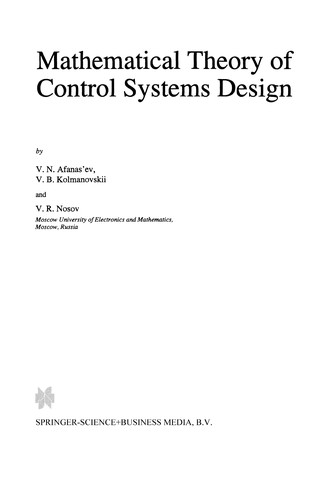
Mathematical Theory of Control Systems Design
0
0
As an Amazon Associate and affiliate partner, Menrva Books earns from qualifying purchases. Learn more
Author Description
The many interesting topics covered in Mathematical Theory of Control Systems Design are spread over an Introduction and four parts. Each chapter concludes with a brief review of the main results and formulae, and each part ends with an exercise section. Part One treats the fundamentals of modern stability theory. Part Two is devoted to the optimal control of deterministic systems. Part Three is concerned with problems of the control of systems under random disturbances of their parameters, and Part Four provides an outline of modern numerical methods of control theory. The many examples included illustrate the main assertions, teaching the reader the skills needed to construct models of relevant phenomena, to design nonlinear control systems, to explain the qualitative differences between various classes of control systems, and to apply what they have learned to the investigation of particular systems. Audience: This book will be valuable to both graduate and postgraduate students in such disciplines as applied mathematics, mechanics, engineering, automation and cybernetics.
Menrva's Summary
THE THESIS
This book investigates the mathematical foundations and practical applications of control systems design. It covers the fundamentals of modern stability theory, optimal control of deterministic systems, control of systems under random disturbances, and modern numerical methods in control theory. The text includes numerous examples to illustrate key concepts and equip readers with the skills to model phenomena, design nonlinear control systems, and analyze various control system classes. It is intended for graduate and postgraduate students in applied mathematics, mechanics, engineering, automation, and cybernetics.
THE SCOPE MAP
- Fundamentals of modern stability theory
- Optimal control of deterministic systems
- Control of systems under random disturbances
- Modern numerical methods of control theory
- Numerous examples illustrating main assertions
- Exercises at the end of each part
THE AUTHORITY PERSPECTIVE
The book is structured to provide a comprehensive overview of control systems design, progressing from foundational stability theory to advanced numerical methods. Its inclusion of exercises and summaries at chapter and part ends suggests a pedagogical approach aimed at facilitating learning for students. The detailed coverage of deterministic and stochastic control, alongside numerical techniques, indicates a rigorous treatment of the subject matter, likely appealing to those in advanced academic or research settings.
Page Count:
671
Publication Date:
1996-01-01
ISBN-10:
9048146151
ISBN-13:
9789048146154
Science
Non-Fiction
Cybernetics
Control Theory
Engineering
Applied Mathematics
Mathematics
Community Tags
Similar Books