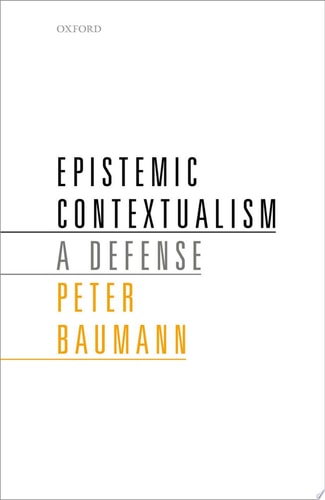
Epistemic Contextualism
0
0
As an Amazon Associate and affiliate partner, Menrva Books earns from qualifying purchases. Learn more
Author Description
Peter Baumann Develops And Defends A Distinctive Version Of Epistemic Contextualism, The View That The Truth Conditions Or The Meaning Of Knowledge Attributions Of The Form S Knows That P Can Vary With The Context Of The Attributor. The First Part Of The Book Examines Arguments For Contextualism And Develops Baumann's Version. The First Chapter Deals With The Argument From Cases And Ordinary Usage; The Following Two Chapters Address Theoretical Arguments, From Reliability And From Luck. The Second Part Of The Book Discusses The Problems Contextualism Faces, To Which It Must Respond, And Provides An Extension Of Contextualism Beyond Epistemology. Chapter 4 Discusses Lottery-scepticism And Argues For A Contextualist Response. Chapter 5 Is Dedicated To A Homemade Problem For Contextualism: A Threat Of Inconsistency. Baumann Argues For A Way Out And For A Version Of Contextualism That Can Underwrite This Solution. Chapter 6 Proposes A Contextualist Account Of Responsibility: The Concept Of Knowledge Is Not The Only One Which Allows For A Contextualist Analysis And It Is Important To Explore Structural Analogies In Other Areas Of Philosophy. The Third Part Of The Book Is Focused On Some Major Objections To Contextualism And Alternative Views, Namely Subject-sensitive Invariantism, Contrastivism And Relativism.
Menrva's Summary
THE THESIS
This book investigates whether the truth conditions of knowledge attributions shift based on the context of the person making the claim. Peter Baumann, a scholar in analytic philosophy, constructs a defense of epistemic contextualism by evaluating both the linguistic foundations of knowledge claims and the theoretical challenges posed by skepticism and inconsistency. He utilizes a structured philosophical framework to argue that contextualism offers a robust solution to traditional epistemological problems while extending the theory into the domain of responsibility.
THE SCOPE MAP
What You Will Find
- Analysis of the argument from cases and ordinary language usage
- Theoretical arguments derived from reliability and luck
- A proposed contextualist response to lottery-scepticism
- A structural analogy between knowledge and responsibility
- Critical evaluation of subject-sensitive invariantism, contrastivism, and relativism
Scope Limits
- The text does not provide an exhaustive history of all epistemological theories
- It does not address non-analytic or continental philosophical perspectives on knowledge
THE AUTHORITY PERSPECTIVE
Experts recognize this work as a rigorous contribution to the ongoing debate regarding the semantics of knowledge attributions. Readers frequently note the high level of academic density and the technical precision required to follow the author's logical arguments.
Page Count:
272
Publication Date:
2016-01-01
Publisher:
Oxford University Press
ISBN-10:
0191069256
ISBN-13:
9780191069253
Philosophy
Logic
Academic
Epistemology
Community Tags
Similar Books