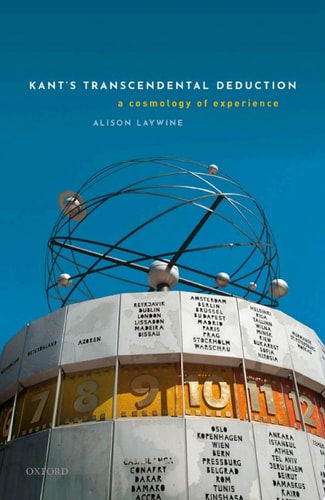
Kant's Transcendental Deduction
0
0
As an Amazon Associate and affiliate partner, Menrva Books earns from qualifying purchases. Learn more
Author Description
In this book, Alison Laywine takes up the mystery of the Transcendental Deduction in Immanuel Kant's Critique of Pure Reason. What is it supposed to accomplish and how? She collects evidence from the Critique and his other writings to determine what Kant took himself to be doing on his own terms and argues that he deliberately adapted elements of his early metaphysics both to set the agenda of the Deduction and to carry it out. She shows that the most important metaphysical element Kant repurposed for the Deduction was his early account of a world: he had argued that a world is not just the sum-total of all substances created by God, but a whole unified by God's universal laws of community that externally relate any given substance to all others. From this conception of a world, Kant then extracted a distinctive way to conceive key elements in the Deduction: experience is thus the whole of all possible appearances unified by the universal laws human understanding gives to nature. This cosmological conception of experience drives the Deduction.
Menrva's Summary
THE THESIS
This book investigates the core purpose and methodology of the Transcendental Deduction within Immanuel Kant's Critique of Pure Reason. Alison Laywine, a scholar of Kantian philosophy, examines the evolution of Kant's thought by synthesizing evidence from the Critique and his earlier metaphysical writings. She argues that Kant intentionally integrated his early cosmological theories regarding the unity of the world into the structure of the Deduction to define the relationship between human understanding and nature.
THE SCOPE MAP
What You Will Find
- Analysis of the Transcendental Deduction in the Critique of Pure Reason
- Examination of Kant's early metaphysical accounts of substances and community
- Theoretical framework linking cosmological unity to the laws of human understanding
Scope Limits
- Does not provide a general introduction to Kantian philosophy for lay readers
- Focuses primarily on the Deduction rather than the entirety of the Critique
THE AUTHORITY PERSPECTIVE
Scholars and students of Kantian philosophy frequently note the technical rigor and academic density of Laywine's prose. Experts highlight this work as a significant contribution to understanding the developmental continuity in Kant's philosophical project.
Page Count:
326
Publication Date:
2020-01-01
Publisher:
OUP Oxford
ISBN-10:
0191065757
ISBN-13:
9780191065750
Philosophy
Philosophy & Religion
Knowledge Theory
Epistemology
Academic
Metaphysics
Philosophy history
Kant
Community Tags
Similar Books