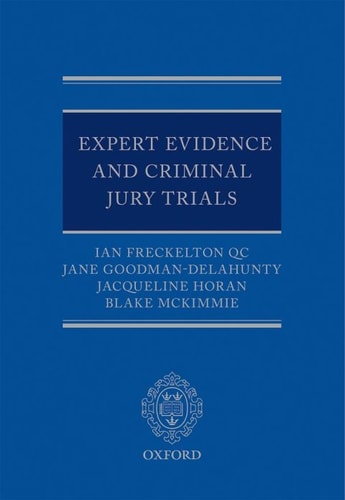
Expert Evidence and Criminal Jury Trials
0
0
As an Amazon Associate and affiliate partner, Menrva Books earns from qualifying purchases. Learn more
Author Description
With expert evidence used more and more often in criminal jury cases, evaluation of its admissibility and presentation is being increasingly thrust into the spotlight. However, jury room secrecy has long prevented a rigorous analysis of its complexities. Expert Evidence and Criminal Jury Trials draws on an unprecedented study carried out in Commonwealth jurisdictions which have recently granted access to jurors, offering a unique exploration of the presentation and comprehension of expert evidence in criminal jury trials and a critical perspective on parallel UK processes. The authors combine empirical research conducted in the courtroom with expert academic analysis, examining, analysing, and comparing the views of not only real jurors, but also courtroom lawyers, judges, and experts across over 50 trials to gauge how complex and sometimes conflicting expert evidence is perceived and understood by all parties. Examples of modern technologies used in expert evidence, including DNA analysis and facial and body-mapping, are considered, and discussion of the challenges they pose covers not only issues of procedure and approach, but also perceptual issues and those of cognitive evaluation. This innovative study aims to facilitate a broader understanding of the use of expert evidence, what problems exist with it, and how such problems influence the communication of information to jurors. While the survey that informs the book relates to criminal trials in three Australian jurisdictions, the legal and psychological issues explored transcend national boundaries, allowing this book to fill a gap in the market for a practical discussion of expert evidence and its use that will be relevant to practitioners in any jurisdiction which utilises an adversarial trial system or juries in criminal trials.
Menrva's Summary
THE THESIS
This book investigates how jurors, lawyers, and judges perceive and comprehend complex expert evidence within the constraints of the criminal jury trial system. The authors, a multidisciplinary team of legal scholars and psychologists, utilize empirical data gathered from over 50 criminal trials across Australian jurisdictions. By bridging the gap between courtroom practice and cognitive psychology, the text argues that current methods of presenting expert testimony often fail to account for the limitations of human information processing and jury room dynamics.
THE SCOPE MAP
What You Will Find
- Empirical data from over 50 criminal trials involving expert testimony
- Analysis of modern forensic technologies including DNA analysis and facial mapping
- Examination of cognitive evaluation and perceptual challenges in the courtroom
- Comparative perspectives on UK and Australian legal processes
Scope Limits
- The primary empirical survey is restricted to three specific Australian jurisdictions
- The text does not provide a comprehensive manual for courtroom advocacy techniques
THE AUTHORITY PERSPECTIVE
Legal practitioners and academics frequently cite this work as a critical resource for understanding the intersection of forensic science and jury decision-making. Experts highlight the text's unique contribution in providing empirical evidence to address long-standing questions regarding jury comprehension of complex technical data.
Page Count:
261
Publication Date:
2016-01-01
Publisher:
OUP Oxford
ISBN-10:
0191063398
ISBN-13:
9780191063398
Psychology
Jury
Professional Career & Trade
Law
Evidence Law
Forensic Science
Legal Studies
Community Tags
Similar Books