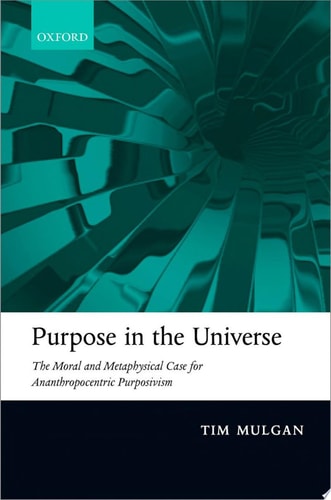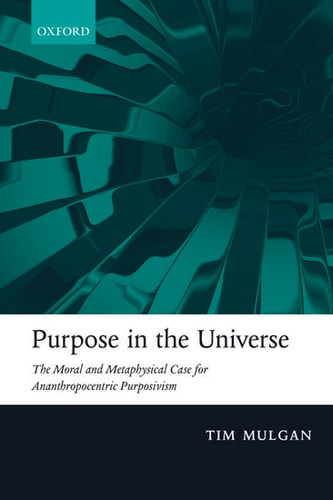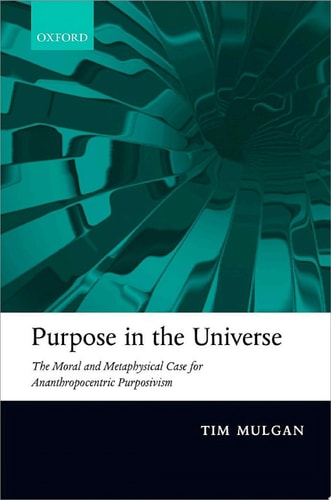
Purpose in the Universe: The Moral and Metaphysical Case for Ananthropocentric Purposivism
0
0
As an Amazon Associate and affiliate partner, Menrva Books earns from qualifying purchases. Learn more
Author Description
Two familiar worldviews dominate Western philosophy: materialist atheism and the benevolent God of the Abrahamic faiths. Tim Mulgan explores a third way. Ananthropocentric Purposivism claims that there is a cosmic purpose, but human beings are irrelevant to it. Purpose in the Universe develops a philosophical case for Ananthropocentric Purposivism that it is at least as strong as the case for either theism or atheism. The book borrows traditional theist arguments to defend a cosmic purpose. These include cosmological, teleological, ontological, meta-ethical, and mystical arguments. It then borrows traditional atheist arguments to reject a human-centred purpose. These include arguments based on evil, diversity, and the scale of the universe. Mulgan also highlights connections between morality and metaphysics, arguing that evaluative premises play a crucial and underappreciated role in metaphysical debates about the existence of God, and Ananthropocentric Purposivism mutually supports an austere consequentialist morality based on objective values. He concludes that, by drawing on a range of secular and religious ethical traditions, a non-human-centred cosmic purpose can ground a distinctive human morality. Our moral practices, our view of the moral universe, and our moral theory are all transformed if we shift from the familiar choice between a universe without meaning and a universe where humans matter to the less self-aggrandising thought that, while it is about something, the universe is not about us.
Menrva's Summary
THE THESIS
This book investigates whether a coherent philosophical case can be made for 'Ananthropocentric Purposivism,' the claim that the universe possesses a cosmic purpose that is entirely independent of human existence. Tim Mulgan, a professor of philosophy, constructs this argument by synthesizing traditional theist and atheist frameworks. He utilizes cosmological, teleological, and ontological arguments to establish the existence of purpose, while simultaneously employing arguments regarding the scale of the universe and the problem of evil to reject human-centric significance. The work posits that evaluative premises are central to metaphysical debates and that this non-human-centered purpose provides a foundation for an austere consequentialist morality.
THE SCOPE MAP
What You Will Find
- A comparative analysis of materialist atheism, Abrahamic theism, and Ananthropocentric Purposivism.
- A re-evaluation of traditional arguments including the cosmological, teleological, and ontological proofs.
- An exploration of the intersection between meta-ethics and metaphysical claims about the universe.
- A proposed framework for a human morality derived from a non-human-centered cosmic purpose.
Scope Limits
- The text does not provide empirical scientific evidence for cosmic purpose, focusing instead on philosophical and logical argumentation.
- It does not attempt to resolve specific theological disputes within existing religious traditions, but rather uses them as structural components for the broader argument.
THE AUTHORITY PERSPECTIVE
Philosophical scholars recognize this work as a rigorous attempt to expand the boundaries of the traditional debate between theism and atheism. Readers frequently note the high level of academic density and the sophisticated logical structure required to follow Mulgan's synthesis of disparate metaphysical traditions.
Page Count:
443
Publication Date:
2015-01-01
Publisher:
OUP Oxford
ISBN-10:
0191066575
ISBN-13:
9780191066573
Philosophy
Ethics
Religion
Metaphysics
Theology
Atheism
Cosmology
Religious ethics
Community Tags
Similar Books