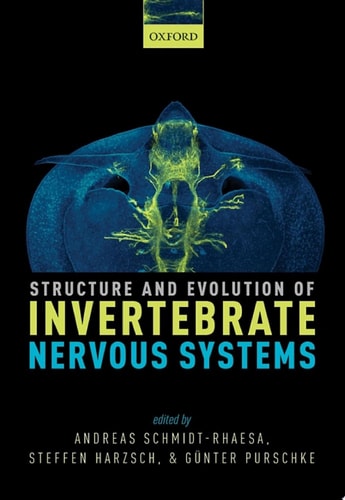
Structure and Evolution of Invertebrate Nervous Systems
0
0
As an Amazon Associate and affiliate partner, Menrva Books earns from qualifying purchases. Learn more
Author Description
The nervous system is particularly fascinating for many biologists because it controls animal characteristics such as movement, behavior, and coordinated thinking. Invertebrate neurobiology has traditionally been studied in specific model organisms, whilst knowledge of the broad diversity of nervous system architecture and its evolution among metazoan animals has received less attention. This is the first major reference work in the field for 50 years, bringing together many leading evolutionary neurobiologists to review the most recent research on the structure of invertebrate nervous systems and provide a comprehensive and authoritative overview for a new generation of researchers. Presented in full colour throughout, Structure and Evolution of Invertebrate Nervous Systems synthesizes and illustrates the numerous new findings that have been made possible with light and electron microscopy. These include the recent introduction of new molecular and optical techniques such as immunohistochemical staining of neuron-specific antigens and fluorescence in-situ-hybridization, combined with visualization by confocal laser scanning microscopy. New approaches to analysing the structure of the nervous system are also included such as micro-computational tomography, cryo-soft X-ray tomography, and various 3-D visualization techniques. The book follows a systematic and phylogenetic structure, covering a broad range of taxa, interspersed with chapters focusing on selected topics in nervous system functioning which are presented as research highlights and perspectives. This comprehensive reference work will be an essential companion for graduate students and researchers alike in the fields of metazoan neurobiology, morphology, zoology, phylogeny and evolution.
Menrva's Summary
THE THESIS
This work investigates the broad diversity of nervous system architecture and its evolutionary trajectory across the metazoan lineage. Edited by Andreas Schmidt-Rhaesa, Günter Purschke, and Steffen Harzsch, the text synthesizes contributions from leading evolutionary neurobiologists to address the historical gap in comprehensive invertebrate neurobiology. It provides a systematic framework for understanding how nervous systems have adapted and diversified, utilizing modern imaging and molecular data to update the field's foundational knowledge.
THE SCOPE MAP
What You Will Find
- Systematic and phylogenetic analysis of nervous system structures across diverse invertebrate taxa
- Methodologies including immunohistochemical staining, fluorescence in-situ-hybridization, and confocal laser scanning microscopy
- Advanced imaging techniques such as micro-computational tomography and cryo-soft X-ray tomography
- Research highlights focusing on specific topics in nervous system functioning
Scope Limits
- Does not cover vertebrate neurobiology
- Does not provide an exhaustive behavioral analysis of every individual species
THE AUTHORITY PERSPECTIVE
Experts recognize this volume as a significant reference work that fills a long-standing void in the literature for evolutionary neurobiology. Researchers and graduate students frequently cite the text for its detailed synthesis of modern imaging techniques and its systematic approach to invertebrate phylogeny.
Page Count:
760
Publication Date:
2015-01-01
Publisher:
OUP Oxford
ISBN-10:
0191066214
ISBN-13:
9780191066214
Science
Zoology
Reference
Biology
Neurobiology
Evolutionary Biology
Community Tags
Other Editions(3)

Similar Books














Reader Comments
Share Your Thoughts
No comments yet. Be the first to share your thoughts!