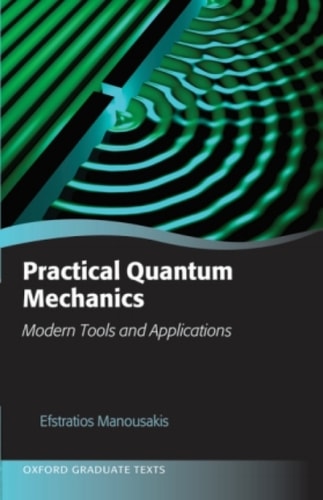
Practical Quantum Mechanics: Modern Tools and Applications
0
0
As an Amazon Associate and affiliate partner, Menrva Books earns from qualifying purchases. Learn more
Author Description
Quantum mechanics forms the foundation of all modern physics, including atomic, nuclear, and molecular physics, the physics of the elementary particles, condensed matter physics. Modern astrophysics also relies heavily on quantum mechanics. Quantum theory is needed to understand the basis for new materials, new devices, the nature of light coming from stars, the laws which govern the atomic nucleus, and the physics of biological systems. As a result the subject of this book is a required course for most physics graduate students. While there are many books on the subject, this book targets specifically graduate students and it is written with modern advances in various fields in mind. Many examples treated in the various chapters as well as the emphasis of the presentation in the book are designed from the perspective of such problems. For example, the book begins by putting the Schrödinger equation on a spatial discrete lattice and the continuum limit is also discussed, inspired by Hamiltonian lattice gauge theories. The latter and advances in quantum simulations motivated the inclusion of the path integral formulation. This formulation is applied to the imaginary-time evolution operator to project the exact ground state of the harmonic oscillator as is done in quantum simulations. As an example of how to take advantage of symmetry in quantum mechanics, one-dimensional periodic potentials are discussed, inspired by condensed matter physics. Atoms and molecules are discussed within mean-field like treatment (Hartree-Fock) and how to go beyond it. Motivated by the recent intense activity in condensed matter and atomic physics to study the Hubbard model, the electron correlations in the hydrogen molecule are taken into account by solving the two-site Hubbard model analytically. Using the canonical Hamiltonian quantization of quantum electrodynamics, the photons emerge as the quanta of the normal modes, in the same way as the phonons emerge in the treatment of the norm
Menrva's Summary
THE THESIS
How can graduate-level physics students master the foundational principles of quantum mechanics through the lens of modern computational and theoretical applications? Efstratios Manousakis, a physicist with extensive experience in condensed matter and many-body systems, constructs a pedagogical framework that bridges traditional quantum theory with contemporary research methodologies. By integrating Hamiltonian lattice gauge theories, path integral formulations, and mean-field approximations, the text prepares students to address complex problems in modern astrophysics, material science, and quantum simulation.
THE SCOPE MAP
What You Will Find
- Discrete lattice representations of the Schrödinger equation.
- Path integral formulations applied to imaginary-time evolution operators.
- Analytical solutions for the two-site Hubbard model in molecular systems.
- Canonical Hamiltonian quantization of quantum electrodynamics.
Scope Limits
- The text assumes a prior foundational understanding of undergraduate-level quantum mechanics.
- It does not provide an exhaustive historical survey of quantum theory, focusing instead on modern applications.
THE AUTHORITY PERSPECTIVE
Experts identify this text as a specialized resource for graduate students seeking to connect theoretical quantum mechanics with current computational research practices. Readers frequently note the technical density of the prose, which requires a strong background in linear algebra and classical mechanics to fully comprehend.
Page Count:
344
Publication Date:
2015-01-01
Publisher:
OUP Oxford
ISBN-10:
0191066303
ISBN-13:
9780191066306
Science
Earth Sciences
Academic
textbook
Physics
Community Tags
Similar Books