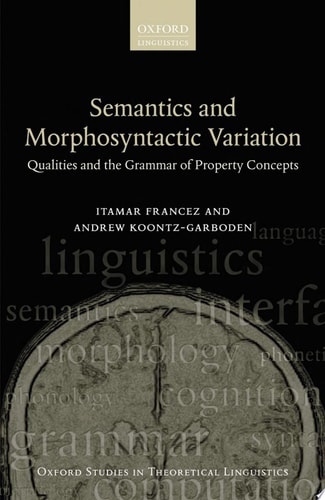
Semantics and Morphosyntactic Variation
0
0
As an Amazon Associate and affiliate partner, Menrva Books earns from qualifying purchases. Learn more
Author Description
This is an open access title available under the terms of a CC BY-NC-ND 4.0 international licence. It is free to read at Oxford Scholarship Online and offered as a free PDF download from OUP and selected open access locations. This book explores a key issue in linguistic theory, the systematic variation in form between semantic equivalents across languages. Two contrasting views of the role of lexical meaning in the analysis of such variation can be found in the literature: (i) Uniformity, whereby lexical meaning is universal, and variation arises from idiosyncratic differences in the inventory and phonological shape of language-particular functional material, and (ii) Transparency, whereby systematic variation in form arises from systematic variation in the meaning of basic lexical items. In this volume, Itamar Francez and Andrew Koontz-Garboden contrast these views as applied to the empirical domain of property concept sentences - sentences expressing adjectival predication and their translational equivalents across languages. They demonstrate that property concept sentences vary systematically between possessive and predicative form, and propose a transparentist analysis of this variation that links it to the lexical denotations of basic property concept lexemes. At the heart of the analysis are qualities: mass-like model theoretic objects that closely resemble scales. The authors contrast their transparentist analysis with uniformitarian alternatives, demonstrating its theoretical and empirical advantages. They then show that the proposed theory of qualities can account for interesting and novel observations in two central domains of grammatical theory: the theory of syntactic categories, and the theory of mass nouns. The overall results highlight the importance of the lexicon as a locus of generalizations about the limits of crosslinguistic variation.
Menrva's Summary
THE THESIS
This book investigates the core question of why languages exhibit systematic variation in form between semantic equivalents, specifically focusing on property concept sentences. Authors Itamar Francez and Andrew Koontz-Garboden utilize a comparative linguistic framework to evaluate two competing theories: the Uniformity hypothesis, which posits universal lexical meaning, and the Transparency hypothesis, which argues that form variation stems from systematic differences in lexical meaning. By analyzing property concept sentences—those expressing adjectival predication—the authors propose a transparentist model centered on 'qualities' as mass-like model-theoretic objects.
THE SCOPE MAP
What You Will Find
- A comparative analysis of property concept sentences across diverse languages.
- A formal semantic framework utilizing 'qualities' to explain cross-linguistic variation.
- Theoretical applications to the study of syntactic categories and mass nouns.
Scope Limits
- The analysis is primarily restricted to property concept sentences and their translational equivalents.
- The text does not provide an exhaustive survey of all known linguistic theories regarding lexical variation.
THE AUTHORITY PERSPECTIVE
Experts in formal semantics and theoretical linguistics recognize this work as a rigorous contribution to the debate between uniformitarian and transparentist approaches to lexical meaning. Readers frequently note the high level of technical density, making it a specialized resource for researchers and graduate students in the field of syntax and semantics.
Page Count:
256
Publication Date:
2017-01-01
Publisher:
Oxford University Press
ISBN-10:
0191062030
ISBN-13:
9780191062032
Linguistics
Morphosyntax
Language Theory
Semantics
Academic
Community Tags
Similar Books