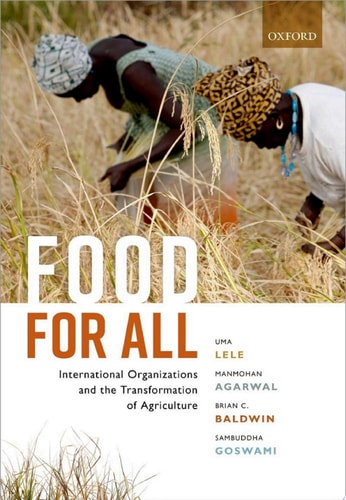
Food for All: International Organizations and the Transformation of Agriculture
0
0
As an Amazon Associate and affiliate partner, Menrva Books earns from qualifying purchases. Learn more
Author Description
Many developing countries are falling behind sustainable development goals: food and nutrition levels have deteriorated due to conflict, climate change, and the Covid pandemic, while global ambitions for achieving sustainable food security and adequate nutrition have increased. But what are the prospects of achieving sustainable, healthy food for all? What is the best response to concerns about growing differentiation among developing countries in terms of domestic agricultural and industrial performance? How have global institutions, established during the post-World War Two period, helped developing countries to deal with the past economic fallout of food, fuel, and financial crises? Food for All explores how developments since these organizations were established have led to changes in the provision of international financial and technical assistance in support of the global food and agriculture system and how developing countries' own efforts have helped transform them These developments, and the increase in the number of global actors, have expanded and complicated global governance, presenting both opportunities for as well as challenges to the improvement of food systems. This volume provides an analysis of the structure, coordination, and management of the Food and Agriculture Organization of the United Nations (FAO), the International Fund for Agricultural Development (IFAD), and the World Food Programme (WFP). It also looks at the World Bank, the largest international funder of policy advice and investment projects, and CGIAR, a leading funder of international agricultural research. This is an open access title available under the terms of a CC BY-NC-ND 4.0 International licence. It is free to read at Oxford Scholarship Online and offered as a free PDF download from OUP and selected open access locations.
Menrva's Summary
THE THESIS
This volume investigates the efficacy and evolution of international organizations in addressing global food security and agricultural development amidst modern crises. The authors, including Uma J. Lele and a team of policy experts, utilize historical data and institutional analysis to evaluate how post-World War Two organizations have adapted to the shifting landscape of global food systems. The work argues that while global governance has expanded, the complexity of these institutions presents both significant opportunities and persistent challenges for developing nations seeking sustainable nutrition and agricultural growth.
THE SCOPE MAP
What You Will Find
- Analysis of the structural management and coordination of the FAO, IFAD, and WFP.
- Evaluation of the World Bank's role in policy advice and investment projects.
- Assessment of CGIAR's contribution to international agricultural research.
- Examination of the impact of climate change, conflict, and pandemics on food systems.
Scope Limits
- The text focuses primarily on institutional governance rather than localized, on-the-ground farming techniques.
- It does not provide a comprehensive history of every individual developing nation's agricultural policy.
THE AUTHORITY PERSPECTIVE
Experts identify this volume as a critical resource for understanding the intersection of international finance and agricultural development policy. Readers frequently note the academic density of the prose, making it a foundational text for students and practitioners of global governance.
Page Count:
208
Publication Date:
2021-01-01
Publisher:
OUP Oxford
ISBN-10:
0191071439
ISBN-13:
9780191071430
Agriculture
Public Policy
International relations
Community Tags
Similar Books

Reader Comments
Share Your Thoughts
No comments yet. Be the first to share your thoughts!