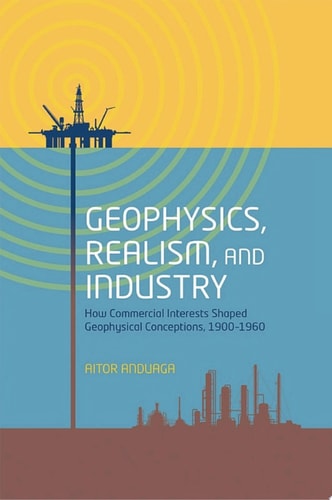
Geophysics, Realism, and Industry: How Commercial Interests Shaped Geophysical Conceptions, 1900-1960
0
0
As an Amazon Associate and affiliate partner, Menrva Books earns from qualifying purchases. Learn more
Author Description
Did industry and commerce affect the concepts, values and epistemic foundations of different sciences? If so, how and to what extent? This book suggests that the most significant influence of industry on science in the two case studies treated here had to do with the issue of realism. Using wave propagation as the common thread, this is the first book to simultaneously analyse the emergence of realist attitudes towards the entities of the ionosphere and of the earth's crust. However, what led physicists and engineers to adopt realist attitudes? This book suggests that a new kind of realism --a realism of social and cultural origins- is the answer: a preliminary, entity realism responding to specific commercial and engineering interests, and a realism that was neither strictly instrumental nor exclusively operational. The book has two parts: while Part I focuses on the study of the ionosphere and how the British radio industry affected ionospheric physics, Part II focuses on the study of the Earth's crust and how the American oil industry affected crustal seismology.
Menrva's Summary
THE THESIS
This book investigates how commercial and industrial interests fundamentally shaped the development of geophysical concepts and the adoption of realist attitudes within the scientific community between 1900 and 1960. Aitor Anduaga, a historian of science, utilizes a comparative framework to examine the intersection of physics and engineering. By analyzing the evolution of wave propagation theories, the author argues that a distinct form of entity realism emerged, driven not by purely theoretical breakthroughs but by the practical requirements of the radio and oil industries.
THE SCOPE MAP
What You Will Find
- Comparative analysis of ionospheric physics and crustal seismology
- Examination of the British radio industry and American oil industry influence
- Theoretical framework regarding the emergence of social and cultural realism in science
- Historical documentation of wave propagation research from 1900 to 1960
Scope Limits
- Does not provide a comprehensive history of all geophysical disciplines
- Focuses primarily on the specific influence of commercial entities rather than broader geopolitical factors
THE AUTHORITY PERSPECTIVE
Scholars in the history of science recognize this work as a significant contribution to understanding the external pressures on scientific epistemology. Readers frequently note the academic density of the prose and the rigorous archival research supporting the author's claims.
Page Count:
357
Publication Date:
2015-01-01
Publisher:
OUP Oxford
ISBN-10:
0191071390
ISBN-13:
9780191071393
History
Realism
Geophysics
Science History
Technology Industry
Sociology of Science
Earth Sciences
Academic
Community Tags
Similar Books