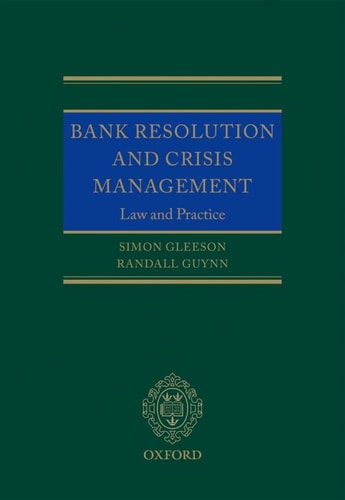
Bank Resolution and Crisis Management: Law and Practice
0
0
As an Amazon Associate and affiliate partner, Menrva Books earns from qualifying purchases. Learn more
Author Description
The 2008 global financial crisis ushered in the biggest explosion in new bank regulation around the world since the Great Depression. Even more so than then, this new regulation has been coordinated on a global basis and reflects global standards as well as local idiosyncracies. Although governments and regulators have sought to put measures in place to prevent the failure of banks, they have acknowledged the need for measures to address what happens when banks fail or are threatened with failure and how to resolve such failure. Bank Resolution and Crisis Management: Law and Practice deals with the measures which European, U.S. and international law and policy makers have sought to put in place to deal with the threat of financial institutions failing, including enhanced supervision, early intervention and so called 'living wills'. Measures such as 'bail-out' (protecting private shareholders and creditors against losses) and 'bail-in' (imposing losses on shareholders and long-term creditors without causing contagion among short-term creditors) are discussed. The work includes comprehensive summaries and commentary on the EU Bank Recovery and Resolution Directive, the UK resolution laws including the Banking Act 2009 and amendments to that act, the Orderly Liquidation Authority under Title II of the U.S. Dodd-Frank Act, proposed new Chapter 14 to the U.S. Bankruptcy Code, and the bank resolution provisions of the U.S. Federal Deposit Insurance Act. The book also provides detailed commentary on the provisions in the Banking Act 2009 dealing with resolution, including discussion of the stabilisation, bank administration and insolvency powers. This includes analysis of secondary legislation such as the Partial Transfers Order. Special emphasis is given to the practical effect of such measures on financial transactions and their impact on arrangements, such as netting and set-off. There is also commentary on the Financial Services Investor Compensation Scheme and its rol
Menrva's Summary
THE THESIS
This text investigates the legal and regulatory frameworks established globally to manage the failure of financial institutions in the post-2008 economic landscape. Authors Randall Guynn and Simon Gleeson, both experts in financial law, synthesize international standards and specific national statutes to explain how authorities intervene when banks face insolvency. The book argues that modern resolution mechanisms, such as bail-in strategies and living wills, are necessary to prevent systemic contagion while balancing the interests of shareholders and creditors.
THE SCOPE MAP
What You Will Find
- Analysis of the EU Bank Recovery and Resolution Directive and UK Banking Act 2009.
- Examination of the U.S. Dodd-Frank Act and Federal Deposit Insurance Act provisions.
- Technical discussion on bail-out versus bail-in methodologies.
- Practical implications for financial transactions, netting, and set-off arrangements.
Scope Limits
- The text focuses primarily on European and U.S. jurisdictions rather than emerging market banking laws.
- It does not provide a general history of banking, focusing strictly on resolution and crisis management protocols.
THE AUTHORITY PERSPECTIVE
Legal professionals and financial regulators frequently cite this work as a primary reference for understanding the complexities of bank insolvency law. Experts highlight the book's technical precision and its utility in navigating the intersection of international policy and domestic statutory requirements.
Page Count:
369
Publication Date:
2016-01-01
Publisher:
OUP Oxford
ISBN-10:
0191077461
ISBN-13:
9780191077463
Economics
Finance
Law
Bank failures
Professional Career & Trade
Banking
Regulation
Community Tags
Similar Books