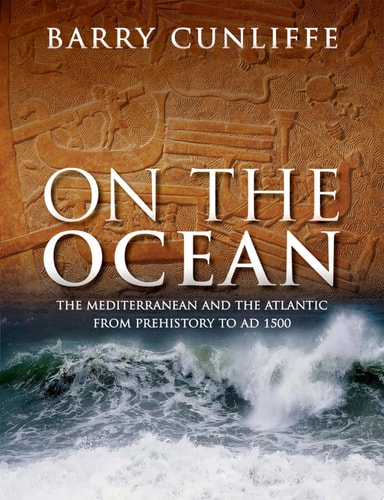
On the Ocean: The Mediterranean and the Atlantic from Prehistory to AD 1500
0
0
As an Amazon Associate and affiliate partner, Menrva Books earns from qualifying purchases. Learn more
Author Description
For humans the sea is, and always has been, an alien environment. Ever moving and ever changing in mood, it is a place without time, in contrast to the land which is fixed and scarred by human activity giving it a visible history. While the land is familiar, even reassuring, the sea is unknown and threatening. By taking to the sea humans put themselves at its mercy. It has often been perceived to be an alien power teasing and cajoling. The sea may give but it takes. Why, then, did humans become seafarers? Part of the answer is that we are conditioned by our genetics to be acquisitive animals: we like to acquire rare materials and we are eager for esoteric knowledge, and society rewards us well for both. Looking out to sea most will be curious as to what is out there - a mysterious island perhaps but what lies beyond? Our innate inquisitiveness drives us to explore. Barry Cunliffe looks at the development of seafaring on the Mediterranean and the Atlantic, two contrasting seas — the Mediterranean without a significant tide, enclosed and soon to become familiar, the Atlantic with its frightening tidal ranges, an ocean without end. We begin with the Middle Palaeolithic hunter gatherers in the eastern Mediterranean building simple vessels to make their remarkable crossing to Crete and we end in the early years of the sixteenth century with sailors from Spain, Portugal and England establishing the limits of the ocean from Labrador to Patagonia. The message is that the contest between humans and the sea has been a driving force, perhaps the driving force, in human history.
Menrva's Summary
THE THESIS
This work investigates how the human drive to explore and acquire resources transformed the Mediterranean and Atlantic seas from alien, threatening environments into vital conduits for civilization. Barry Cunliffe, a distinguished archaeologist, utilizes a vast array of archaeological evidence, historical records, and geographical analysis to argue that the interaction between humans and the sea has been a primary catalyst for historical development. He posits that innate human inquisitiveness and the desire for rare materials compelled societies to master maritime navigation despite the inherent dangers of the ocean. The text frames the evolution of seafaring as a fundamental contest that shaped the trajectory of human history from prehistory through the early sixteenth century.
THE SCOPE MAP
What You Will Find
- Analysis of maritime development from the Middle Palaeolithic period to the early 1500s.
- Comparative study of the Mediterranean's enclosed, tideless environment versus the Atlantic's vast, tidal nature.
- Examination of early vessel construction and navigation techniques.
- Historical accounts of exploration from the eastern Mediterranean to the expansion of European sailors to the Americas.
Scope Limits
- The narrative concludes at the early sixteenth century and does not cover modern maritime history.
- The focus remains primarily on the Mediterranean and Atlantic basins, excluding Pacific or Indian Ocean developments.
THE AUTHORITY PERSPECTIVE
Scholars and readers frequently praise this work for its comprehensive synthesis of archaeological data and its ability to connect disparate historical periods through a unified maritime lens. Experts highlight the text as a foundational resource for understanding the environmental and social pressures that drove early human expansion across the seas.
Page Count:
627
Publication Date:
2017-01-01
Publisher:
OUP Oxford
ISBN-10:
0191075345
ISBN-13:
9780191075346
History
Maritime history
European History
Civilization
Expeditions & Discoveries
Archaeology
Social History
Geography
Community Tags
Similar Books