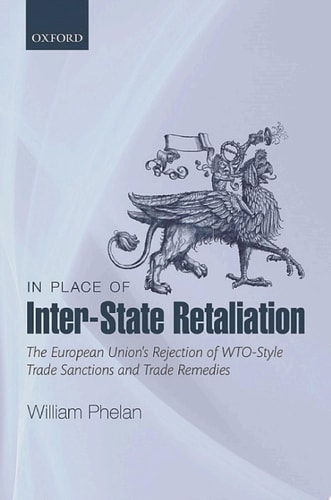
In Place of Inter-State Retaliation: The European Union's Rejection of WTO-style Trade Sanctions and Trade Remedies
0
0
As an Amazon Associate and affiliate partner, Menrva Books earns from qualifying purchases. Learn more
Author Description
Unlike many other trade regimes, the European Union forbids the use of inter-state retaliation to enforce its obligations, and rules out the use of common 'escape' mechanisms such as anti-dumping between the EU member states. How does the EU do without these mechanisms that appear so vital to the political viability of other international trade regimes, including the World Trade Organization? How, therefore, is the European legal order, with the European Court of Justice at its centre, able to be so much more binding and intrusive than the legal obligations of many other trade regimes? This book puts forward a new explanation of a key part of the European Union's legal system, emphasising its break with the inter-state retaliation mechanisms and how Europe's special form of legal integration is facilitated by intra-industry trade, parliamentary forms of national government, and European welfare states. It argues first that the EU member states have allowed the enforcement of EU obligations by domestic courts in order to avoid the problems associated with enforcing trade obligations by constant threats of trade retaliation. It argues second that the EU member states have been able to accept such a binding form of dispute settlement and treaty obligation because the policy adjustments required by the European legal order were politically acceptable. High levels of intra-industry trade reduced the severity of the economic adjustments required by the expansion of the European market, and inclusive and authoritative democratic institutions in the member states allowed policy-makers to prioritise a general interest in reliable trading relationships even when policy changes affected significant domestic lobbies. Furthermore, generous national social security arrangements protected national constituents against any adverse consequences arising from the expansion of European law and the intensification of the European market. The European legal order should therefore be unde
Menrva's Summary
THE THESIS
This book investigates how the European Union maintains a highly binding and intrusive legal order without relying on the inter-state retaliation mechanisms or trade remedies common to other international trade regimes like the WTO. William Phelan, an expert in European law and politics, utilizes a comparative framework to analyze the unique enforcement mechanisms of the EU. He argues that the EU's success in legal integration is predicated on the role of domestic courts, high levels of intra-industry trade, and the presence of robust national welfare states that mitigate the political costs of economic adjustment.
THE SCOPE MAP
What You Will Find
- Analysis of the European Court of Justice's role in treaty enforcement.
- Examination of the relationship between intra-industry trade and market integration.
- Discussion of how parliamentary government structures influence trade policy.
- Evaluation of the role of national social security systems in maintaining political stability.
Scope Limits
- The text does not provide a comprehensive history of all EU trade agreements.
- It does not focus on the specific technicalities of anti-dumping procedures outside of their rejection within the EU.
THE AUTHORITY PERSPECTIVE
Scholars in the field of European legal studies frequently cite this work for its clear explanation of the structural differences between the EU and the WTO. Experts highlight the book as a significant contribution to understanding the political economy of international legal integration.
Page Count:
195
Publication Date:
2014-01-01
Publisher:
OUP Oxford
ISBN-10:
0191075485
ISBN-13:
9780191075483
Economics
International relations
Trade Policy
Law
European Union
Europe
Community Tags
Similar Books











Reader Comments
Share Your Thoughts
No comments yet. Be the first to share your thoughts!