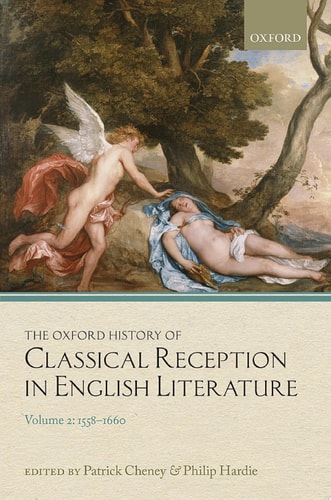
The Oxford History of Classical Reception in English Literature: Volume 2: 1558-1660
0
0
As an Amazon Associate and affiliate partner, Menrva Books earns from qualifying purchases. Learn more
Author Description
The Oxford History of Classical Reception (OHCREL) is designed to offer a comprehensive investigation of the numerous and diverse ways in which literary texts of the classical world have stimulated responses and refashioning by English writers. Covering the full range of English literature from the early Middle Ages to the present day, OHCREL both synthesizes existing scholarship and presents cutting-edge new research, employing an international team of expert contributors for each of the five volumes. OHCREL endeavours to interrogate, rather than inertly reiterate, conventional assumptions about literary 'periods', the processes of canon-formation, and the relations between literary and non-literary discourse. It conceives of 'reception' as a complex process of dialogic exchange and, rather than offering large cultural generalizations, it engages in close critical analysis of literary texts. It explores in detail the ways in which English writers' engagement with classical literature casts as much light on the classical originals as it does on the English writers' own cultural context. This second volume covers the years 1558-1660, and explores the reception of the ancient genres and authors in English Renaissance literature, engaging with the major, and many of the minor, writers of the period, including Shakespeare, Marlowe, Spenser, and Jonson. Separate chapters examine the Renaissance institutions and contexts which shape the reception of antiquity, and an annotated bibliography provides substantial material for further reading.
Menrva's Summary
THE THESIS
This volume investigates how the literature of the classical world was received, adapted, and transformed by English writers during the period of 1558 to 1660. Editors Patrick Cheney and Philip Hardie, alongside a team of international scholars, utilize close critical analysis to challenge traditional assumptions regarding canon formation and the cultural dialogue between antiquity and the English Renaissance. The work argues that this engagement with classical texts functions as a reciprocal process, illuminating both the ancient sources and the specific cultural contexts of the Elizabethan and early Stuart eras.
THE SCOPE MAP
What You Will Find
- Analysis of classical reception in English literature from 1558 to 1660.
- Examination of major and minor authors including Shakespeare, Marlowe, Spenser, and Jonson.
- Investigation of Renaissance institutions and social contexts that influenced the interpretation of antiquity.
- An annotated bibliography for further research.
Scope Limits
- The volume is restricted to the specific timeframe of 1558-1660 and does not cover subsequent or preceding centuries.
- The text focuses on literary reception rather than broad cultural or political history outside of the literary sphere.
THE AUTHORITY PERSPECTIVE
Scholars and students of Renaissance literature regard this series as a foundational reference for understanding the transmission of classical influence. Readers frequently note the academic density of the prose and the rigorous, text-focused methodology employed by the contributors.
Page Count:
802
Publication Date:
2015-01-01
Publisher:
OUP Oxford
ISBN-10:
0191077798
ISBN-13:
9780191077791
History
Literary Criticism
English
Greece
English & College Success
Academic
English literature
Community Tags
Similar Books