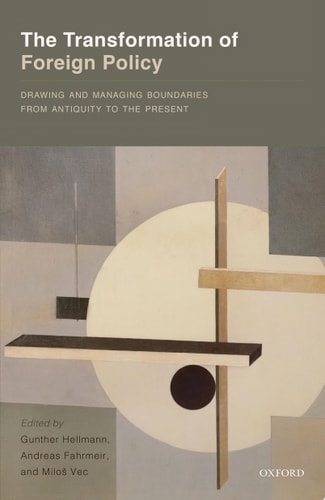
The Transformation of Foreign Policy
0
0
As an Amazon Associate and affiliate partner, Menrva Books earns from qualifying purchases. Learn more
Author Description
The Study Of Foreign Policy Is Usually Concerned With The Interaction Of States, And Thus With Governance Structures Which Emerged Either With The So-called 'westphalian System' Or In The Course Of The 18th Century: Diplomacy And International Law. As A Result, Examining Foreign Policy In Earlier Periods Involves Conceptual And Terminological Difficulties, Which Echo Current Debates On 'post-national' Foreign Policy Actors Like The European Union Or Global Cities. This Volume Argues That A Novel Understanding Of What Constitutes Foreign Policy May Offer A Way Out Of This Problem. It Considers Foreign Policy As The Outcome Of Processes That Make Some Boundaries Different From Others, And Set Those That Separate Communities In An Internal Space Apart From Those That Mark Foreignness. The Creation Of Such Boundaries, Which Can Be Observed At All Times, Designates Specific Actors - Which Can Be, But Do Not Have To Be, 'states' - As Capable Of Engaging In Foreign Policy. As Such Boundaries Are Likely To Be Contested, They Are Unlikely To Provide Either A Single Or A Simple Distinction Between 'insides' And 'outsides'. In This View, Multiple Layers Of Foreign-policy Actors With Different Characteristics Appear Less As A Modern Development And More As A Perennial Aspect Of Foreign Policy. In A Broad Perspective Stretching From Early Greek Polities To Present-day Global Cities, The Volume Offers A Theoretical And Empirical Presentation Of This Concept By Political Scientists, Jurists, And Historians.
Menrva's Summary
THE THESIS
This volume investigates whether a redefined conceptual framework of foreign policy, centered on the creation of boundaries rather than state-centric interactions, can resolve the terminological difficulties inherent in studying pre-modern and post-national political actors. The authors, a multidisciplinary team of political scientists, jurists, and historians, argue that foreign policy should be understood as the process of distinguishing internal spaces from foreign ones. By shifting the focus from the Westphalian state model to the functional creation of boundaries, the contributors propose that multiple layers of foreign-policy actors have existed throughout history, rather than being a strictly modern phenomenon.
THE SCOPE MAP
What You Will Find
- A theoretical framework defining foreign policy as a boundary-making process.
- Historical analysis ranging from early Greek polities to contemporary global cities.
- Multidisciplinary perspectives integrating political science, legal history, and international relations theory.
Scope Limits
- The text does not provide a comprehensive history of specific diplomatic events or treaties.
- It does not offer a predictive model for future international relations or specific policy recommendations for current state actors.
THE AUTHORITY PERSPECTIVE
Experts highlight this volume as a significant contribution to the theoretical literature on international relations, particularly for its attempt to bridge the gap between historical practice and modern political theory. Readers frequently note the academic density of the prose, which is intended for scholars and advanced students of political science and history.
Page Count:
296
Publication Date:
2016-01-01
Publisher:
Oxford University Press
ISBN-10:
019108641X
ISBN-13:
9780191086410
History
Diplomacy
Political Theory
International relations
International Law
Community Tags
Similar Books