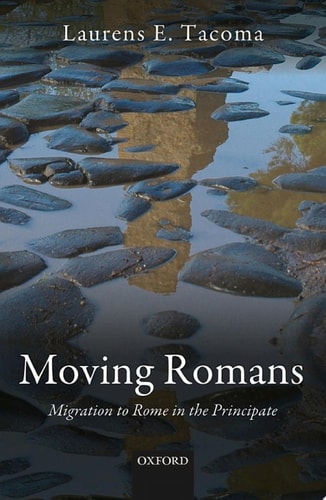
Moving Romans: Migration to Rome in the Principate
0
0
As an Amazon Associate and affiliate partner, Menrva Books earns from qualifying purchases. Learn more
Author Description
While the importance of migration in contemporary society is universally acknowledged, historical analyses of migration put contemporary issues into perspective. Migration is a phenomenon of all times, but it can take many different forms. The Roman case is of real interest as it presents a situation in which the volume of migration was high, and the migrants in question formed a mixture of voluntary migrants, slaves, and soldiers. Moving Romans offers an analysis of Roman migration by applying general insights, models and theories from the field of migration history. It provides a coherent framework for the study of Roman migration on the basis of a detailed study of migration to the city of Rome in the first two centuries A.D. Advocating an approach in which voluntary migration is studied together with the forced migration of slaves and the state-organised migration of soldiers, it discusses the nature of institutional responses to migration, arguing that state controls focused mainly on status preservation rather than on the movement of people. It demonstrates that Roman family structure strongly favoured the migration of young unmarried males. Tacoma argues that in the case of Rome, two different types of the so-called urban graveyard theory, which predicts that cities absorbed large streams of migrants, apply simultaneously. He shows that the labour market which migrants entered was relatively open to outsiders, yet also rather crowded, and that although ethnic community formation could occur, it was hardly the dominant mode by which migrants found their way into Rome because social and economic ties often overrode ethnic ones. The book shows that migration impinges on social relations, on the Roman family, on demography, on labour relations, and on cultural interaction, and thus deserves to be placed high on the research agenda of ancient historians.
Menrva's Summary
THE THESIS
This work investigates the patterns, motivations, and institutional responses surrounding migration to the city of Rome during the first two centuries A.D. Laurens Ernst Tacoma, an expert in ancient history, utilizes modern migration theory and demographic models to analyze the Roman experience. By synthesizing data on voluntary migrants, enslaved populations, and soldiers, he constructs a framework that challenges traditional views on how the Roman state managed population movement and social integration.
THE SCOPE MAP
What You Will Find
- Analysis of migration patterns during the Principate period (1st-2nd centuries A.D.)
- Application of the urban graveyard theory to ancient Roman demographics
- Examination of Roman family structures and their influence on migration trends
- Assessment of labor market dynamics and ethnic community formation
Scope Limits
- The study focuses primarily on the city of Rome rather than the broader Roman Empire
- The analysis does not cover the late antique or post-imperial periods
THE AUTHORITY PERSPECTIVE
Historians and scholars of the ancient world recognize this text as a significant contribution to the study of Roman social history and demography. Readers frequently note the academic rigor of the prose and the effectiveness of applying modern sociological models to classical historical data.
Page Count:
316
Publication Date:
2016-01-01
Publisher:
OUP Oxford
ISBN-10:
0191080969
ISBN-13:
9780191080968
History
Demography
Roman History
Rome
Labor Mobility
Migration Studies
Sociology
Ancient History
Community Tags
Similar Books