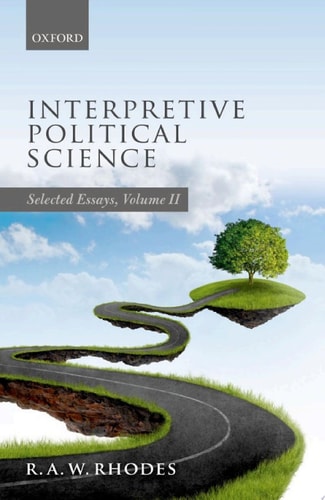
Interpretive Political Science: Selected Essays, Volume II
0
0
As an Amazon Associate and affiliate partner, Menrva Books earns from qualifying purchases. Learn more
Author Description
Interpretive Political Science is the second of two volumes featuring a selection of key writings by R.A.W. Rhodes. Volume II looks forward and explores the 'interpretive turn' and its implications for the craft of political science, especially public administration, and draws together articles from 2005 onwards on the theme of 'the interpretive turn' in political science. Part I provides a summary statement of the interpretive approach, and Part II develops the theme of blurring genres and discusses a variety of research methods common in the humanities, including: ethnographic fieldwork, life history, and focus groups. Part III demonstrates how the genres of thought and presentation found in the humanities can be used in political science. It presents four examples of such blurring 'at work' with studies of: applied anthropology and civil service reform; women's studies and government departments; and storytelling and local knowledge. The book concludes with a summary of what is edifying about an interpretive approach, and why this approach matters, and revisits some of the more common criticisms before indulging in plausible conjectures about the future of interpretivism. The author seeks new and interesting ways to explore governance, high politics, public policies, and the study of public administration in general. Volume I collects in one place for the first time the main articles written by Rhodes on policy networks and governance between 1990 and 2005, and explores a new way of describing British government, focusing on policy making and the ways in which policy is put into practice.
Menrva's Summary
THE THESIS
This volume investigates the methodological and theoretical implications of the 'interpretive turn' within the discipline of political science. R.A.W. Rhodes, a prominent scholar in public administration, compiles his research from 2005 onward to argue for the integration of humanities-based research methods into political analysis. By examining how ethnographic and narrative approaches can inform the study of governance and policy, the author provides a framework for expanding the traditional boundaries of political science research.
THE SCOPE MAP
What You Will Find
- Methodological frameworks for ethnographic fieldwork, life history, and focus groups in political contexts.
- Case studies applying humanities-based research to civil service reform and government departments.
- A critical evaluation of the 'interpretive turn' and its future trajectory in public administration.
Scope Limits
- The text focuses primarily on the interpretive approach and does not provide a comprehensive overview of quantitative political science methodologies.
- The volume is limited to the author's specific research interests and selected essays published after 2005.
THE AUTHORITY PERSPECTIVE
Scholars and students of public administration frequently cite this work as a significant contribution to the methodological diversification of the field. Experts note that the prose is accessible yet academically rigorous, making it a useful resource for those interested in the intersection of political science and the humanities.
Page Count:
288
Publication Date:
2017-01-01
Publisher:
OUP Oxford
ISBN-10:
0191089338
ISBN-13:
9780191089336
Public Administration
Governance
Essays
Community Tags
Similar Books

![Time Bites [Signed and Contemporarily Dated]](https://storage.googleapis.com/menrva_img_storage/covers/9780007179855.jpg)