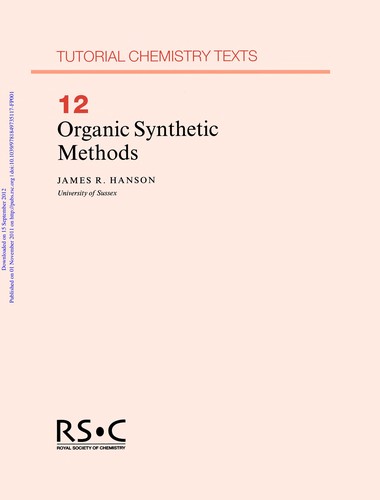
Organic Synthetic Methods
0
0
As an Amazon Associate and affiliate partner, Menrva Books earns from qualifying purchases. Learn more
Author Description
Synthesis is one of the major endeavours of the organic chemist, and the design of a successful synthesis requires a sound knowledge of functional group chemistry, stereochemistry and organic reaction mechanisms.Organic Synthetic Methods introduces the major methods of creating carbon-carbon and carbon-nitrogen bonds, along with functional group interconversions (oxidation, reduction, halogenation). The use of protecting groups and solid-phase methods are also discussed. The analysis of the structure of a target molecule, in terms of the structural consequences of synthetic reactions, is introduced to enable the student to identify key dissections and building blocks and hence develop a suitable synthetic method. Examples of the synthesis of labelled compounds are also provided.Ideal for the needs of undergraduate chemistry students, Tutorial Chemistry Texts is a major new series consisting of short, single topic or modular texts concentrating on the fundamental areas of chemistry taught in undergraduate science courses. Each book provides a concise account of the basic principles underlying a given subject, embodying an independent-learning philosophy and including worked examples.
Menrva's Summary
THE THESIS
The design of a successful organic synthesis hinges on a deep understanding of fundamental chemical principles. This text introduces students to the major methods for forming carbon-carbon and carbon-nitrogen bonds, alongside essential functional group transformations such as oxidation, reduction, and halogenation. It also covers the strategic use of protecting groups and modern solid-phase techniques. The book emphasizes the analysis of target molecules by dissecting their structures to identify key building blocks and develop effective synthetic routes, including examples of synthesizing labeled compounds.
THE SCOPE MAP
- Major methods for creating carbon-carbon bonds
- Major methods for creating carbon-nitrogen bonds
- Functional group interconversions: oxidation, reduction, halogenation
- The use of protecting groups in synthesis
- Solid-phase synthetic methods
- Analysis of target molecule structure for synthetic planning
- Identification of key dissections and building blocks
- Examples of the synthesis of labeled compounds
THE AUTHORITY PERSPECTIVE
This text is designed as an introductory resource for undergraduate chemistry students, focusing on the core principles of organic synthesis. Its modular approach, with worked examples, supports an independent-learning philosophy. The content covers essential techniques for bond formation and functional group manipulation, aiming to equip students with the analytical skills needed to design synthetic pathways. The book's structure suggests it serves as a foundational text for those beginning their study of synthetic organic chemistry.
Page Count:
175
Publication Date:
2002-01-01
ISBN-10:
1849735115
ISBN-13:
9781849735117
Science
Organic chemistry
Chemical synthesis
Community Tags
Similar Books