
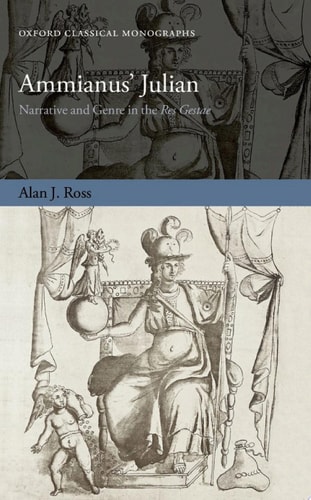
Ammianus' Julian: Narrative and Genre in the Res Gestae
0
0
As an Amazon Associate and affiliate partner, Menrva Books earns from qualifying purchases. Learn more
Author Description
Ammianus Marcellinus' Res Gestae Holds A Prominent Position In Modern Studies Of The Emperor Julian As The Fullest Extant Narrative Of The Reign Of The Last 'pagan' Emperor. Ammianus' Julian: Narrative And Genre In The Res Gestae Offers A Major Reinterpretation Of The Work, Which Is One Of The Main Narrative Sources For The Political History Of The Later Roman Empire, And Argues For A Re-examination Of Ammianus' Agenda And Methods In Narrating The Reign Of Julian. Building On Recent Developments In The Application Of Literary Approaches And Critical Theories To Historical Texts, Ammianus' Presentation Of Julian Is Evaluated By Considering The Res Gestae Within Three Interrelated Contexts: As A Work Of Latin Historiography, Which Consciously Sets Itself Within A Classical And Classicizing Generic Tradition; In A More Immediate Literary And Political Context, As The Final Contribution By A Member Of An 'eyewitness' Generation To A Quarter Century Of Intense Debate Over Julian's Legacy By Several Authors Who Had Lived Through His Reign And Had Been In Varying Degrees Of Proximity To Julian Himself; And As A Narrative Text, In Which Narratorial Authority Is Closely Associated With The Persona Of The Narrator, Both As An External Narrating Agent And An Occasional Participant In The Events He Relates. This Is Complemented By A Literary Survey And A Re-analysis Of Ammianus' Depiction Of Several Key Moments In Julian's Reign, Such As His Appointment As Caesar, The Battle Of Strasbourg In 357ad, His Acclamation As Augustus, And The Disastrous Invasion Of Persia In 363ad. It Suggests That The Res Gestae Presents A Latin-speaking, Western Audience With An Idiosyncratic And 'romanized' Depiction Of The Philhellene Emperor And That, Consciously Exploiting His Position As A Greek Writing In Latin And As A Contemporary Of Julian, Ammianus Wished His Work To Be Considered A Culminating And Definitive Account Of The Man And His Life.
Menrva's Summary
THE THESIS
This study investigates how Ammianus Marcellinus constructed his narrative of the Emperor Julian to establish a definitive, Romanized account of the final pagan ruler. Alan J. Ross, a scholar of classical literature and history, utilizes contemporary literary theory to analyze the Res Gestae as a deliberate construction of historical memory. By situating the text within the broader tradition of Latin historiography, Ross argues that Ammianus manipulated his persona as both an eyewitness and a Greek author writing in Latin to influence the political legacy of Julian.
THE SCOPE MAP
What You Will Find
- Analysis of the Res Gestae as a work of classical Latin historiography
- Examination of the political debates surrounding Julian's legacy among his contemporaries
- Literary analysis of key narrative moments including the Battle of Strasbourg and the Persian invasion
- Evaluation of the narrator's persona as both an external agent and participant
Scope Limits
- The study focuses primarily on the literary and historiographical construction of Julian rather than a comprehensive biography of the emperor's life
- It does not provide an exhaustive archaeological or military history of the 4th century
THE AUTHORITY PERSPECTIVE
Scholars recognize this work as a significant contribution to the study of Ammianus Marcellinus, particularly for its focus on the intersection of narrative technique and historical agenda. Readers frequently note the academic density of the prose, which is intended for specialists in late antique history and classical literature.
Page Count:
272
Publication Date:
2016-01-01
Publisher:
Oxford University Press
ISBN-10:
0191087858
ISBN-13:
9780191087851
History
Biography
Ancient - Rome
Literary Criticism
Historiography
Community Tags
Other Editions(2)
Similar Books

Reader Comments
Share Your Thoughts
No comments yet. Be the first to share your thoughts!