Authorial Personality and the Making of Renaissance Texts: The Force of Character
0
0
As an Amazon Associate and affiliate partner, Menrva Books earns from qualifying purchases. Learn more
Author Description
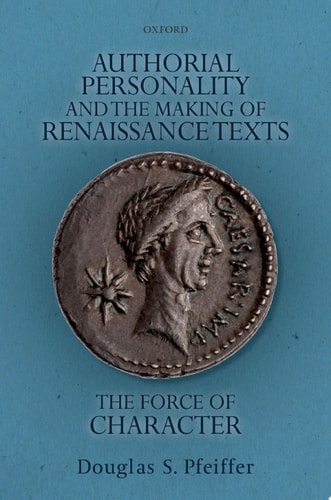
How did we first come to believe in a correspondence between writers' lives and their works? When did the person of the author--both as context and target of textual interpretation--come to matter so much to the way we read? This book traces the development of author centrism back to the scholarship of early Renaissance humanists. Working against allegoresis and other traditions of non-historicizing textual reception, they discovered the power of engaging ancient works through the speculative reconstruction of writers' personalities and artistic motives. To trace the multi-lingual and eventually cross-cultural rise of reading for the author, this book presents four case studies of resolutely experimental texts by and about writers of high ambition in their respective generations: Lorenzo Valla on the forger of the Donation of Constantine, Erasmus on Saint Jerome, the poet George Gascoigne on himself, and Fulke Greville on Sir Philip Sidney. An opening methodological chapter and exhortative conclusion frame these four studies with accounts of the central lexicon--character, intention, ethos, persona--and the range of genre evidence that contemporaries used to discern and articulate authorial character and purpose. Constellated throughout with examples from the works of major contemporaries including John Aubrey, John Hayward, Galileo, Machiavelli, and Shakespeare, this volume resurrects a vibrant culture of biographism continuous with modern popular practice and yet radically more nuanced in its strategic reliance on the explanatory power of probabilism and historical conjecture--the discursive middle ground now obscured from view by the post-Enlightenment binaries of truth and fiction, history and story, fact and fable.
Menrva's Summary
THE THESIS
This book investigates the historical origins of author centrism, specifically examining how early Renaissance humanists established the practice of interpreting texts through the lens of a writer's personality and artistic motives. Douglas S. Pfeiffer, a scholar of Renaissance literature, utilizes a framework of historical conjecture and probabilism to challenge modern binary views of fact and fiction. By analyzing the shift away from medieval allegoresis, the author demonstrates how early modern readers developed the tools to reconstruct the ethos and intention of historical figures.
THE SCOPE MAP
What You Will Find
- Analysis of four primary case studies: Lorenzo Valla, Erasmus, George Gascoigne, and Fulke Greville.
- An examination of the lexicon of character, including terms such as intention, ethos, and persona.
- Comparative evidence from contemporaries including John Aubrey, Galileo, Machiavelli, and Shakespeare.
Scope Limits
- The study focuses primarily on the development of authorial interpretation within the Renaissance period and does not provide a comprehensive history of literary theory beyond the post-Enlightenment transition.
THE AUTHORITY PERSPECTIVE
Scholars recognize this work as a significant contribution to the history of reading practices and the evolution of biographical criticism. Readers frequently note the academic density of the prose and the author's meticulous use of primary source evidence to reconstruct early modern intellectual habits.
Page Count:
485
Publication Date:
2020-01-01
Publisher:
OUP Oxford
ISBN-10:
0191082139
ISBN-13:
9780191082139
Biography
English
Literary Criticism
Academic
History of Ideas
Humanism
English & College Success
Community Tags
Similar Books