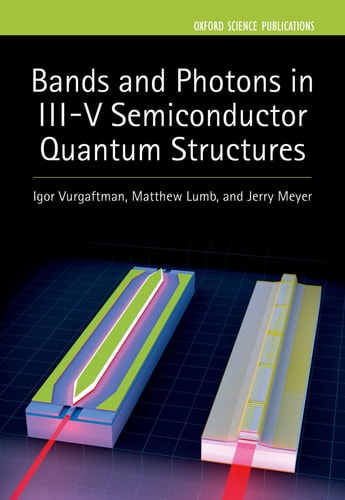
Bands and Photons in III-V Semiconductor Quantum Structures
Author Description
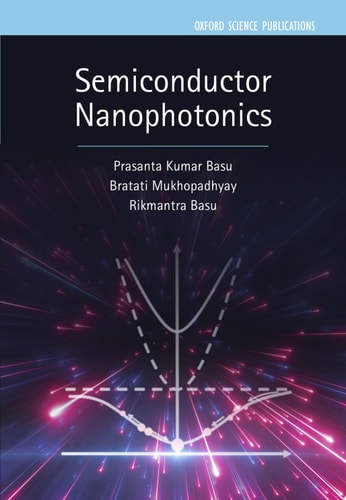
Semiconductor quantum structures are at the core of many photonic devices such as lasers, photodetectors, solar cells etc. To appreciate why they are such a good fit to these devices, we must understand the basic features of their band structure and how they interact with incident light. Many books have taken on this task in the past, but their treatments tend either to pluck results from the literature and present them as received truths or to rely on unrealistically simple models. Bands and Photons in III-V Semiconductor Quantum Structures takes the reader from the very basics of III-V semiconductors (some preparation in quantum mechanics and electromagnetism is helpful) and shows how seemingly obscure results such as detailed forms of the Hamiltonian, optical transition strengths, and recombination mechanisms follow. The reader would not need to consult other references to fully understand the material, although a few handpicked sources are listed for those who would like to deepen their knowledge further. Connections to the properties of novel materials such as graphene and transition metal dichalcogenides are pointed out, to help prepare the reader for contributing at the forefront of research in those fields. The book also supplies a complete, up-to-date database of the band parameters that enter into the calculations, along with tables of optical constants and interpolation schemes for alloys. From these foundations, the book goes on to derive the characteristics of photonic semiconductor devices (with a focus on the mid-infrared) using the same principles of building all concepts from the ground up, explaining all derivations in detail, giving quantitative examples, and laying out dimensional arguments whenever they can help the reader's understanding.
Menrva's Summary
THE THESIS
This text investigates the fundamental relationship between band structure and light interaction in III-V semiconductor quantum structures to provide a rigorous, self-contained derivation of device characteristics. The authors, experts in semiconductor physics, utilize a first-principles approach to move beyond simplified models, offering a comprehensive framework that connects basic quantum mechanics to the performance of advanced photonic devices like lasers and photodetectors.
THE SCOPE MAP
What You Will Find
- Detailed derivations of Hamiltonian forms and optical transition strengths
- A comprehensive database of band parameters and optical constants
- Analysis of recombination mechanisms in III-V materials
- Comparative connections to graphene and transition metal dichalcogenides
Scope Limits
- Requires prior foundational knowledge in quantum mechanics and electromagnetism
- Focuses primarily on mid-infrared photonic applications
THE AUTHORITY PERSPECTIVE
Experts recognize this work as a highly detailed, self-contained resource for researchers and graduate students in the field of semiconductor physics. Readers frequently note the technical density of the prose, which serves as a rigorous reference for those seeking to understand the mathematical foundations of photonic device design.
Page Count:
688
Publication Date:
2020-01-01
Publisher:
OUP Oxford
ISBN-10:
0191080055
ISBN-13:
9780191080050
Science
Materials Science
Physics
Semiconductors
Earth Sciences
Community Tags
Similar Books