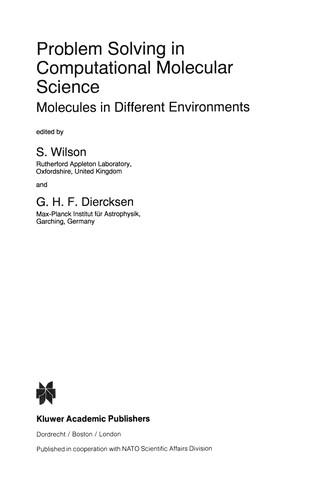
Problem Solving in Computational Molecular Science
0
0
As an Amazon Associate and affiliate partner, Menrva Books earns from qualifying purchases. Learn more
Author Description
For all practical purposes the basic physical equations governing the behaviour of a system at the molecular level can only be solved approximately. The key issue in any reliable and accurate computational study in molecular physics and quantum chemistry is the adoption of a suitable model which contains the essential physics and chemistry, is computationally tractable, and preferably amenable to systematic refinement. The provision of advice on the choice of an appropriate model for a specific problem has so far received scant attention. This issue is becoming acute as 'standard' software packages are becoming widely available and are being increasingly heavily used in both the academic and industrial sectors by researchers who have received no special training in the theoretical physics and chemistry that underpins them. This volume provides researchers whose background may not be in the computational molecular sciences with the necessary background to make intelligent use of the methods available by performing reliable calculations of appropriate accuracy and making a considered interpretation of the data so obtained.
Menrva's Summary
THE THESIS
This volume addresses the critical challenge of selecting and applying appropriate models for computational studies in molecular physics and quantum chemistry. The book aims to equip researchers, particularly those without specialized training in the underlying theoretical sciences, with the knowledge to perform reliable calculations and interpret their results accurately. It focuses on the practical aspects of choosing models that balance essential physical and chemical principles with computational feasibility and the potential for refinement, a need that has become increasingly acute with the widespread availability of standard software packages.
THE SCOPE MAP
- Guidance on selecting appropriate computational models for molecular systems.
- Explanation of the essential physics and chemistry underpinning computational methods.
- Discussion of computational tractability and systematic refinement of models.
- Advice for researchers using standard software packages without extensive theoretical backgrounds.
- Methods for performing reliable calculations of appropriate accuracy.
- Strategies for making considered interpretations of computational data.
THE AUTHORITY PERSPECTIVE
The book is positioned as a practical guide for researchers entering the field of computational molecular science. Its focus on model selection and interpretation suggests it aims to bridge the gap between readily available software and the theoretical underpinnings required for robust scientific inquiry. The content is likely to be of value to those in academic and industrial settings who need to perform reliable calculations without being experts in theoretical physics or chemistry. The emphasis on practical application and data interpretation indicates a focus on enabling effective use of computational tools.
Page Count:
428
Publication Date:
1997-01-01
ISBN-10:
9400900392
ISBN-13:
9789400900394
Non-Fiction
Science
Scientific Computing
Molecular Physics
Computational Chemistry
Community Tags
Similar Books