The Roman Retail Revolution
0
0
As an Amazon Associate and affiliate partner, Menrva Books earns from qualifying purchases. Learn more
Author Description
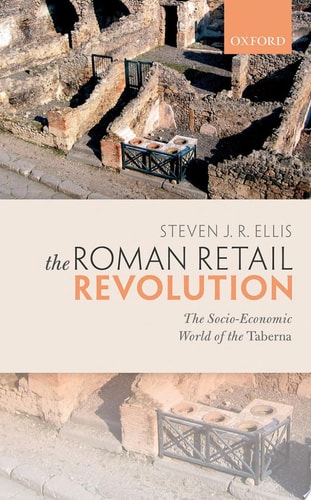
Tabernae were ubiquitous in all Roman cities, lining the busiest streets and dominating their most crowded intersections in numbers far exceeding those of any other form of building. That they played a vital role in the operation of the city, and indeed in the very definition of urbanization in ancient Rome, is a point too often under-appreciated in Roman studies, and one which bears fruitful further exploration. The Roman Retail Revolution offers a thorough investigation into the social and economic worlds of the Roman shop, focusing on food and drink outlets in particular. Combining critical analysis of both archaeological material and textual sources, it challenges many of the conventional ideas about the place of retailing in the Roman city and unravels the historical development of tabernae to identify three major waves or revolutions in the shaping of retail landscapes. The volume is underpinned by two new and important bodies of evidence: the first generated from the University of Cincinnati's recent archaeological excavations into a Pompeian neighborhood of close to twenty shop-fronts, and the second resulting from a field-survey of the retail landscapes of more than a hundred cities from across the Roman world. The richness of this information, combined with the volume's interdisciplinary approach to the lives of the Roman sub-elite, results in a refreshingly original look at the history of retailing and urbanism in the Roman world.
Menrva's Summary
THE THESIS
This work investigates the critical role of the Roman taberna, or shop, in defining the economic and social structure of ancient urban environments. Prof. Steven J. R. Ellis, an expert in Roman archaeology, utilizes a combination of recent excavation data from Pompeii and a broad field survey of over one hundred Roman cities to re-evaluate the importance of retail spaces. He argues that these food and drink outlets were not merely peripheral structures but central drivers of Roman urbanization and social life.
THE SCOPE MAP
What You Will Find
- Analysis of the historical development of Roman retail through three distinct waves of change.
- Data derived from the University of Cincinnati's excavations of a Pompeian neighborhood containing nearly twenty shop-fronts.
- A comparative study of retail landscapes across more than one hundred cities throughout the Roman Empire.
Scope Limits
- The study focuses primarily on food and drink outlets rather than all forms of commercial activity.
- The analysis is limited to the Roman world and does not extend to broader Mediterranean trade networks outside of the urban retail context.
THE AUTHORITY PERSPECTIVE
Experts recognize this volume as a significant contribution to the study of the Roman sub-elite and urban economic history. Readers frequently note the academic rigor of the text, which successfully bridges the gap between archaeological field data and historical synthesis.
Page Count:
320
Publication Date:
2018-01-01
Publisher:
Oxford University Press
ISBN-10:
0191082597
ISBN-13:
9780191082597
History
Economics
Social History
Archaeology
Ancient - Rome
Urban Studies
Community Tags
Similar Books