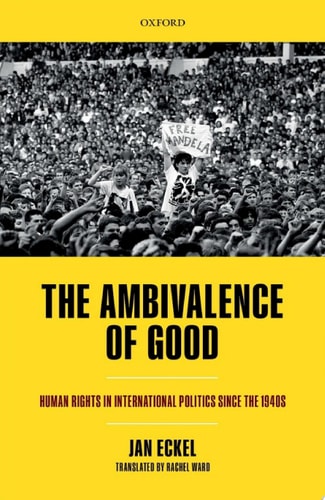
The Ambivalence of Good: Human Rights in International Politics since the 1940s
0
0
As an Amazon Associate and affiliate partner, Menrva Books earns from qualifying purchases. Learn more
Author Description
The Ambivalence of Good examines the genesis and evolution of international human rights politics since the 1940s. Focusing on key developments such as the shaping of the UN human rights system, decolonization, the rise of Amnesty International, the campaigns against the Pinochet dictatorship, the moral politics of Western governments, or dissidence in Eastern Europe, the book traces how human rights profoundly, if subtly, transformed global affairs. Moving beyond monocausal explanations and narratives prioritizing one particular decade, such as the 1940s or the 1970s, The Ambivalence of Good argues that we need a complex and nuanced interpretation if we want to understand the truly global reach of human rights, and account for the hopes, conflicts, and interventions to which this idea gave rise. Thus, it portrays the story of human rights as polycentric, demonstrating how actors in various locales imbued them with widely different meanings, arguing that the political field evolved in a fitful and discontinuous process. This process was shaped by consequential shifts that emerged from the search for a new world order during the Second World War, decolonization, the desire to introduce a new political morality into world affairs during the 1970s, and the visions of a peaceful international order after the end of the Cold War. Finally, the book stresses that the projects pursued in the name of human rights nonetheless proved highly ambivalent. Self-interest was as strong a driving force as was the desire to help people in need, and while international campaigns often improved the fate of the persecuted, they were equally likely to have counterproductive effects. The Ambivalence of Good provides the first research-based synopsis of the topic and one of the first synthetic studies of a transnational political field (such as population, health, or the environment) during the twentieth century. Based on archival research in six countries, it breaks new empirical ground.
Menrva's Summary
THE THESIS
This work investigates the complex evolution of international human rights politics from the 1940s to the present, questioning how these ideals transformed global affairs despite their inherent contradictions. Jan Eckel, a historian specializing in the history of human rights and international politics, utilizes extensive archival research across six countries to construct his argument. He challenges monocausal historical narratives by presenting human rights as a polycentric, discontinuous political field shaped by shifting global orders, decolonization, and the interplay between moral idealism and national self-interest.
THE SCOPE MAP
What You Will Find
- Analysis of the UN human rights system and its development post-WWII.
- Examination of the rise of non-governmental organizations like Amnesty International.
- Case studies on the Pinochet dictatorship, Eastern European dissidence, and decolonization movements.
- A framework for understanding the fitful, non-linear progression of international moral politics.
Scope Limits
- The text does not provide a comprehensive legal analysis of human rights treaties.
- It does not focus on domestic human rights policy outside of its impact on international political fields.
THE AUTHORITY PERSPECTIVE
Experts recognize this text as a significant synthetic study that provides a necessary, research-based overview of a complex transnational political field. Readers frequently note the academic density of the prose, which is well-suited for scholars and students of international history and political science.
Page Count:
454
Publication Date:
2019-01-01
Publisher:
OUP Oxford
ISBN-10:
0191086118
ISBN-13:
9780191086113
History
Human rights
International relations
History - Modern
Diplomatic History
Modern History
Community Tags
Similar Books