The Amorous Restoration: Love, Sex, and Politics in Early Nineteenth-Century France
0
0
As an Amazon Associate and affiliate partner, Menrva Books earns from qualifying purchases. Learn more
Author Description
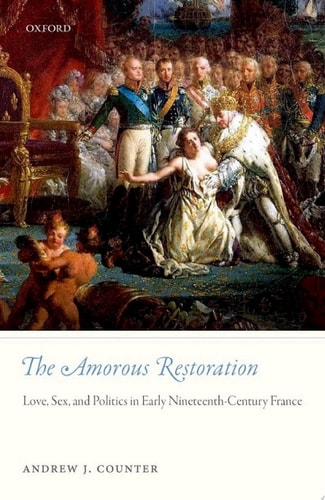
When Louis XVIII returned to the throne in 1814, and again in 1815, France embarked upon a period of uneasy cohabitation between the old and the new. The writers of the age, who included Chateaubriand, Stendhal, Balzac, and Mme de Duras, agreed that they lived at a historical turning point, a transitional moment whose outcome, though still uncertain, would transform the French way of life--beginning with the French way of love. The literary works of the Bourbon Restoration ceaselessly return to the themes of love, sex, and marriage, partly as vital cultural questions in their own right, but also as a means of critiquing the deficiencies of past regimes, negotiating the politics of the present, and imagining the shape of the political future. In the literature of the Restoration, love and politics become entwined in a mutually metaphorical embrace. The Amorous Restoration, the first book in English devoted to literary and cultural life under the last Bourbon kings, considers this relationship in all its richness and many contradictions. Long neglected as a drab historical backwater, the Restoration emerges here as a vibrant era, one rife with sharp cultural and political disagreements, and possessed of an especially refined sense of allusion, discretion, and even humour. Drawing on literature, journalism, political writing, life writing, and gossip, The Amorous Restoration vividly recreates the erotic sensibilities of a pivotal moment in the transition from an amorous old regime to erotic--and political--modernity.
Menrva's Summary
THE THESIS
This book investigates how the literature of the Bourbon Restoration in France utilized themes of love, sex, and marriage as metaphors to navigate and critique the complex political transition between the old regime and modern society. Andrew J. Counter, an academic specialist in nineteenth-century French literature, examines how writers of the period—including Stendhal and Balzac—reconceptualized eroticism to reflect the instability of a nation oscillating between monarchical tradition and emerging political modernity. By analyzing these texts, the author argues that the Restoration was not a stagnant era but a period of intense cultural negotiation where private intimacy served as a proxy for public political discourse.
THE SCOPE MAP
What You Will Find
- Analysis of literary works by Chateaubriand, Stendhal, Balzac, and Mme de Duras
- Examination of the intersection between erotic sensibilities and political ideology
- Integration of diverse source materials including journalism, political pamphlets, and personal correspondence
Scope Limits
- The study focuses primarily on literary and cultural representations rather than exhaustive political or military history of the Bourbon Restoration
- The analysis is confined to the specific timeframe of the Bourbon Restoration in early nineteenth-century France
THE AUTHORITY PERSPECTIVE
Scholars and critics recognize this work as a significant contribution to the study of Restoration-era French culture, noting its ability to reframe a previously overlooked period as a site of intellectual vibrancy. Readers frequently highlight the author's meticulous synthesis of literary analysis and historical context, which provides a nuanced understanding of how private life informed public political identity.
Page Count:
288
Publication Date:
2016-01-01
Publisher:
OUP Oxford
ISBN-10:
0191089117
ISBN-13:
9780191089114
History
European History
Nineteenth century
In literature
English
French History
Literary Criticism
English & College Success
Community Tags
Similar Books