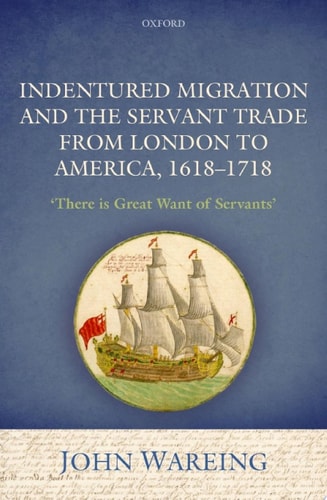
Indentured Migration and the Servant Trade from London to America, 1618-1718: 'There is Great Want of Servants'
0
0
As an Amazon Associate and affiliate partner, Menrva Books earns from qualifying purchases. Learn more
Author Description
The key role played by indentured servants in the settlement and development of the English colonies in the West Indies and the North American mainland in the first century of English colonisation has been overshadowed by interest in the much larger later trade in African slaves. 'There is Great Want of Servants' provides the first full examination of the English trade in indentured servants, which delivered the majority of an estimated 457,000 white people who migrated to the American colonies before 1720. English colonisation intended to create 'new Englands out of England' - to enlarge trade and plantation - but settlement required people to work the land. Labour had to be transported over 4,000 miles of threatening ocean in a new system of indentured servitude, in which people paid for their transportation and keep, with four years of unpaid service for adults, and more for children and adolescents. The system was not benign, neither in the sugar plantations of the West Indies and the tobacco plantations of Maryland and Virginia, nor at the centre of the trade in London and in other ports such as Bristol. Merchants, procurers, and masters of ships often used illicit methods to recruit servants as human cargo. Measures to reduce spiriting by making the offence a felony punishable by hanging, or registering servants in new offices, had little effect. The 1718 Transportation Act eased servant recruitment, but when wars in 1689-1697 and 1702-1713 disrupted the supply of servants, and demand for the addictive products of the sugar and tobacco colonies soared in Britain and Europe, white servants were increasingly substituted by African chattel slaves.
Menrva's Summary
THE THESIS
This work investigates the economic and social mechanics of the indentured servant trade from London to the American colonies between 1618 and 1718. John Wareing, a specialist in historical geography and migration, utilizes primary archival records and port registration data to reconstruct the scale and illicit practices of the labor recruitment system. The text argues that indentured servitude was the foundational labor model for early English colonization, eventually transitioning into chattel slavery as geopolitical conflicts and market demands shifted.
THE SCOPE MAP
What You Will Find
- Quantitative analysis of the estimated 457,000 migrants transported to the colonies before 1720.
- Examination of the 'spiriting' phenomenon and the failure of legislative attempts to regulate recruitment.
- Analysis of the transition from white indentured labor to African chattel slavery in tobacco and sugar plantations.
Scope Limits
- The study focuses primarily on the London-based trade and its specific administrative records.
- It does not provide a comprehensive biography of individual servants, focusing instead on the systemic trade mechanisms.
THE AUTHORITY PERSPECTIVE
Historians recognize this text as a definitive examination of the logistical and human costs associated with early colonial labor systems. Scholars frequently cite the book for its meticulous use of registration records to quantify a previously under-documented aspect of Atlantic migration.
Page Count:
314
Publication Date:
2016-01-01
Publisher:
OUP Oxford
ISBN-10:
0191093262
ISBN-13:
9780191093265
History
United States
Colonial History
Economic History
Social History
Great Britain
Labor history
American History
Migration Studies
Community Tags
Similar Books