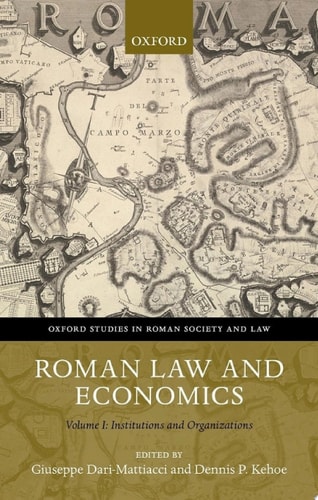
Roman Law and Economics: Institutions and Organizations Volume I
0
0
As an Amazon Associate and affiliate partner, Menrva Books earns from qualifying purchases. Learn more
Author Description
Ancient Rome is the only society in the history of the western world whose legal profession evolved autonomously, distinct and separate from institutions of political and religious power. Roman legal thought has left behind an enduring legacy and exerted enormous influence on the shaping of modern legal frameworks and systems, but its own genesis and context pose their own explanatory problems. The economic analysis of Roman law has enormous untapped potential in this regard: by exploring the intersecting perspectives of legal history, economic history, and the economic analysis of law, the two volumes of Roman Law and Economics are able to offer a uniquely interdisciplinary examination of the origins of Roman legal institutions, their functions, and their evolution over a period of more than 1000 years, in response to changes in the underlying economic activities that those institutions regulated. Volume I explores these legal institutions and organizations in detail, from the constitution of the Roman Republic to the management of business in the Empire, while Volume II covers the concepts of exchange, ownership, and disputes, analysing the detailed workings of credit, property, and slavery, among others. Throughout each volume, contributions from specialists in legal and economic history, law, and legal theory are underpinned by rigorous analysis drawing on modern empirical and theoretical techniques and methodologies borrowed from economics. In demonstrating how these can be fruitfully applied to the study of ancient societies, with due deference to the historical context, Roman Law and Economics opens up a host of new avenues of research for scholars and students in each of these fields and in the social sciences more broadly, offering new ways in which different modes of enquiry can connect with and inform each other.
Menrva's Summary
THE THESIS
This volume investigates how the economic analysis of law can explain the origins, functions, and evolution of Roman legal institutions over a millennium. The authors, Dennis P. Kehoe and Giuseppe Dari-Mattiacci, assemble a collection of interdisciplinary research that bridges the gap between legal history and modern economic theory. By applying rigorous empirical and theoretical methodologies to ancient legal frameworks, the text argues that Roman law evolved in direct response to the changing economic activities and organizational needs of the Roman Republic and Empire.
THE SCOPE MAP
What You Will Find
- Analysis of the constitution of the Roman Republic and its legal foundations.
- Examination of business management and organizational structures within the Roman Empire.
- Application of modern economic theory to ancient legal history.
- Interdisciplinary contributions from specialists in law, legal theory, and economic history.
Scope Limits
- This volume focuses specifically on institutions and organizations, leaving the detailed analysis of exchange, ownership, and disputes for the subsequent second volume.
THE AUTHORITY PERSPECTIVE
Scholars and students of legal history frequently note the academic density and rigorous methodology employed throughout the text. Experts highlight this work as a significant contribution to the field for its successful integration of modern economic analysis with the study of ancient Roman society.
Page Count:
368
Publication Date:
2020-01-01
Publisher:
OUP Oxford
ISBN-10:
0191090980
ISBN-13:
9780191090981
Philosophy
History
Economics
Law
History & Surveys
Roman law
Academic
Legal History
Economics history
Ancient History
Comparative Politics
Ancient - Rome
Professional Career & Trade
Economic History
Community Tags
Similar Books