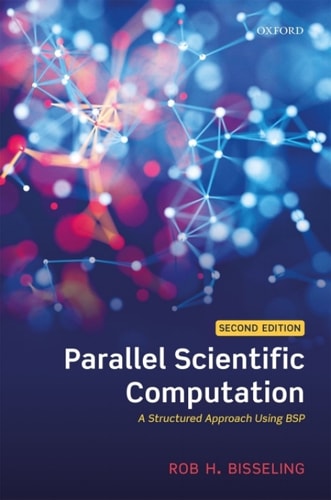
Parallel Scientific Computation: A Structured Approach Using BSP
0
0
As an Amazon Associate and affiliate partner, Menrva Books earns from qualifying purchases. Learn more
Author Description
Building upon the wide-ranging success of the first edition, Parallel Scientific Computation presents a single unified approach to using a range of parallel computers, from a small desktop computer to a massively parallel computer. The author explains how to use the bulk synchronous parallel (BSP) model to design and implement parallel algorithms in the areas of scientific computing and big data, and provides a full treatment of core problems in these areas, starting from a high-level problem description, via a sequential solution algorithm to a parallel solution algorithm and an actual parallel program written in BSPlib. Every chapter of the book contains a theoretical section and a practical section presenting a parallel program and numerical experiments on a modern parallel computer to put the theoretical predictions and cost analysis to the test. Every chapter also presents extensive bibliographical notes with additional discussions and pointers to relevant literature, and numerous exercises which are suitable as graduate student projects. The second edition provides new material relevant for big-data science such as sorting and graph algorithms, and it provides a BSP approach towards new hardware developments such as hierarchical architectures with both shared and distributed memory. A single, simple hybrid BSP system suffices to handle both types of parallelism efficiently, and there is no need to master two systems, as often happens in alternative approaches. Furthermore, the second edition brings all algorithms used up to date, and it includes new material on high-performance linear system solving by LU decomposition, and improved data partitioning for sparse matrix computations. The book is accompanied by a software package BSPedupack, freely available online from the author's homepage, which contains all programs of the book and a set of test driver programs. This package written in C can be run using modern BSPlib implementations such as MulticoreBSP for
Menrva's Summary
THE THESIS
This text investigates the efficacy of the Bulk Synchronous Parallel (BSP) model as a unified framework for designing and implementing parallel algorithms across diverse hardware architectures. Rob H. Bisseling, a specialist in parallel scientific computation, leverages his academic expertise to bridge the gap between high-level problem descriptions and practical implementation. The book argues that a single, hybrid BSP approach simplifies the complexity of managing both shared and distributed memory systems, providing a scalable methodology for scientific and big-data applications.
THE SCOPE MAP
What You Will Find
- Theoretical foundations of the BSP model and cost analysis techniques.
- Practical implementations using BSPlib and the BSPedupack software package.
- Coverage of core scientific problems including LU decomposition, sparse matrix computations, sorting, and graph algorithms.
- Analysis of hierarchical architectures and modern hardware developments.
Scope Limits
- The text focuses specifically on the BSP model and does not provide an exhaustive survey of alternative parallel programming paradigms like MPI or OpenMP.
- It assumes a foundational understanding of sequential algorithm design and C programming.
THE AUTHORITY PERSPECTIVE
Experts recognize this work as a foundational text for graduate-level study in parallel computing due to its rigorous integration of theory and practical experimentation. Readers frequently note the academic density of the prose, which is balanced by the inclusion of extensive exercises and accessible software implementations.
Page Count:
416
Publication Date:
2020-01-01
Publisher:
OUP Oxford
ISBN-10:
0191092576
ISBN-13:
9780191092572
Computer Science
Big data
Professional Career & Trade
Scientific Computing
Algorithms
Programming
Community Tags
Similar Books