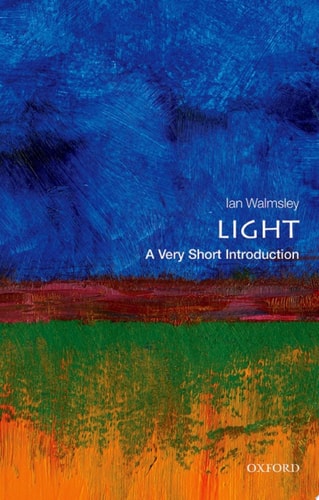
Light: A Very Short Introduction
0
0
As an Amazon Associate and affiliate partner, Menrva Books earns from qualifying purchases. Learn more
Author Description
Light enables us to see the world around us. Our sense of sight provides us with direct information about space and time, the physical arrangement of the world, and how it changes. This almost universal shared sensation of vision has led to a fascination with the nature and properties of light across the ages. But the light we see is just a small part of the whole spectrum of electromagnetic radiation, ranging from radio waves to gamma rays. In this Very Short Introduction Ian Walmsley discusses early attempts to explain light, and the development of apparently opposing particulate and wave theories by scientists such as Isaac Newton and Christiaan Huygens. He shows how light was recognized as an electromagnetic wave in the 19th century, and the development of the quantum mechanics view of wave-particle duality in the 20th century. He also describes the many applications of light, domestic and scientific, such as microwaves, DVDs, and lasers. We now use the whole range of electromagnetic radiation to peer both into the human body and deep into space. Turning to the future of optics, Walmsley concludes by looking at some of the most exciting new developments using quantum light sources in communications and computing. ABOUT THE SERIES: The Very Short Introductions series from Oxford University Press contains hundreds of titles in almost every subject area. These pocket-sized books are the perfect way to get ahead in a new subject quickly. Our expert authors combine facts, analysis, perspective, new ideas, and enthusiasm to make interesting and challenging topics highly readable.
Menrva's Summary
THE THESIS
This book investigates the fundamental nature, properties, and scientific history of light as a component of the electromagnetic spectrum. Ian A. Walmsley, a physicist and academic, utilizes historical scientific milestones and modern physical principles to explain how light transitions from a sensory experience to a complex subject of quantum study. The text argues that understanding light is central to both our perception of the physical world and the advancement of modern technological applications.
THE SCOPE MAP
What You Will Find
- Historical overview of wave versus particle theories of light
- Explanation of the electromagnetic spectrum from radio waves to gamma rays
- Development of quantum mechanics and wave-particle duality
- Practical applications including lasers, communications, and medical imaging
Scope Limits
- Does not provide advanced mathematical derivations of quantum field theory
- Does not serve as a comprehensive textbook for specialized optical engineering
THE AUTHORITY PERSPECTIVE
Experts and readers recognize this text as a highly accessible entry point for those seeking a concise overview of optical physics. The prose is noted for its clarity in distilling complex historical and scientific concepts into a digestible format for the general reader.
Page Count:
152
Publication Date:
2015-01-01
Publisher:
OUP Oxford
ISBN-10:
0191505161
ISBN-13:
9780191505164
Science
Non-Fiction
Earth Sciences
Optics
Light
Physics