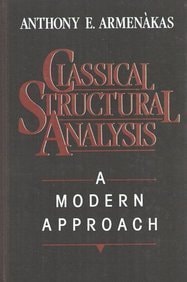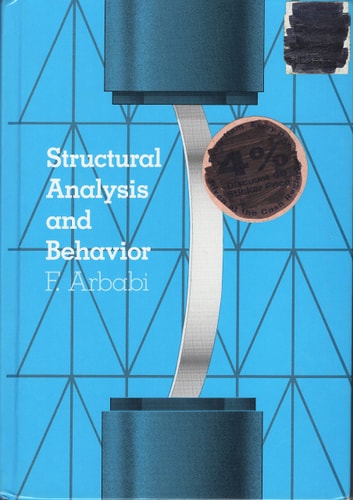
Structural Analysis and Behavior
0
0
As an Amazon Associate and affiliate partner, Menrva Books earns from qualifying purchases. Learn more
Author Description
Structural Analysis and Behavior presents the methods of structural analysis with an emphasis on the physical behavior of structures. It strikes an important balance between the classical methods of analysis-which provide useful means of understanding the concepts and the behavior of structures-and modern matrix methods,which present systematic general solution procedures. In addition,the direct stiffness method,now the most common method of solution because of its generality and ease of programming,is the matrix method used throughout the book. An introduction to the flexibility method for beams,trusses,and frames is also presented. In keeping with the book's emphasis on behavior,the author has provided readers with one very unique feature: simple laboratory experiments on reduced scale models. These experiments,found at the end of each chapter,help readers understand the more difficult topics and help them visualize certain abstract concepts.
Menrva's Summary
THE THESIS
This text investigates the relationship between classical structural analysis techniques and modern matrix-based computational methods to provide a comprehensive understanding of structural behavior. Author Freydoon Arbabi utilizes his academic background to bridge the gap between theoretical manual calculations and the systematic, programmable procedures required in contemporary engineering practice. The book argues that a deep understanding of physical behavior is necessary to effectively apply matrix methods in professional design environments.
THE SCOPE MAP
What You Will Find
- Classical methods of structural analysis for beams, trusses, and frames
- Matrix methods with a focus on the direct stiffness method
- Laboratory experiments using reduced scale models to visualize abstract concepts
- Introduction to the flexibility method
Scope Limits
- Advanced non-linear structural dynamics
- Finite element analysis beyond standard matrix procedures
THE AUTHORITY PERSPECTIVE
Experts highlight this text as a valuable resource for students who require a bridge between traditional hand-calculation methods and modern computational workflows. Readers frequently note that the inclusion of physical laboratory experiments provides a distinct advantage in visualizing complex structural mechanics.
Page Count:
585
Publication Date:
1991-01-01
Publisher:
McGraw-Hill College
ISBN-10:
0070021430
ISBN-13:
9780070021433
New Used & Rental Textbooks
Technology
Civil Engineering
Science & Math
textbook
Mechanics
Structural analysis
Engineering
Community Tags
Similar Books