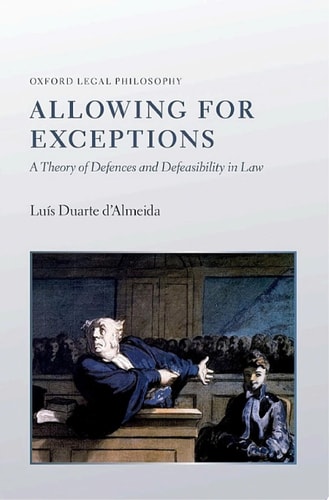
Allowing for Exceptions: A Theory of Defences and Defeasibility in Law
0
0
As an Amazon Associate and affiliate partner, Menrva Books earns from qualifying purchases. Learn more
Author Description
You find yourself in a court of law, accused of having hit someone. What can you do to avoid conviction? You could simply deny the accusation: 'No, I didn't do it'. But suppose you did do it. You may then give a different answer. 'Yes, I hit him', you grant, 'but it was self-defence'; or 'Yes, but I was acting under duress'. To answer in this way-to offer a 'Yes, but...' reply-is to hold that your particular wrong was committed in exceptional circumstances. Perhaps it is true that, as a rule, wrongdoers ought to be convicted. But in your case the court should set the rule aside. You should be acquitted. Within limits, the law allows for exceptions. Or so we tend to think. In fact, the line between rules and exceptions is harder to draw than it seems. How are we to determine what counts as an exception and what as part of the relevant rule? The distinction has important practical implications. But legal theorists have found the notion of an exception surprisingly difficult to explain. This is the longstanding jurisprudential problem that this book seeks to solve. The book is divided into three parts. Part I, Defeasibility in Question, introduces the topic and articulates the core puzzle of defeasibility in law. Part II, Defeasibility in Theory, develops a comprehensive proof-based account of legal exceptions. Part III, Defeasibility in Action, looks more closely into the workings of exceptions in accusatory contexts, including the criminal trial.
Menrva's Summary
THE THESIS
This book investigates the jurisprudential problem of defining and categorizing legal exceptions, specifically focusing on the relationship between rules and defeasibility in law. Luís Duarte d'Almeida, a scholar in legal philosophy, utilizes a proof-based analytical framework to examine how legal systems accommodate 'Yes, but...' arguments in criminal trials. The work seeks to clarify the conceptual boundary between a general rule and the exceptional circumstances that warrant an acquittal.
THE SCOPE MAP
What You Will Find
- A comprehensive proof-based account of legal exceptions
- Analysis of the 'Yes, but...' reply structure in legal proceedings
- Examination of defeasibility within the context of criminal trials
- A tripartite structure covering the puzzle, the theory, and the practical application of exceptions
Scope Limits
- The text does not provide a practical guide for legal practitioners or defense attorneys
- It does not cover specific case law outside of the theoretical framework of defeasibility
THE AUTHORITY PERSPECTIVE
Legal scholars and students of jurisprudence frequently highlight this text as a rigorous exploration of the logical structure of legal norms. Experts note the high level of academic density, making it a foundational resource for those studying the intersection of logic and legal theory.
Page Count:
320
Publication Date:
2015-01-01
Publisher:
OUP Oxford
ISBN-10:
0191508993
ISBN-13:
9780191508998
Professional Career & Trade
Academic
Criminal Law
Jurisprudence
Law
Community Tags
Similar Books