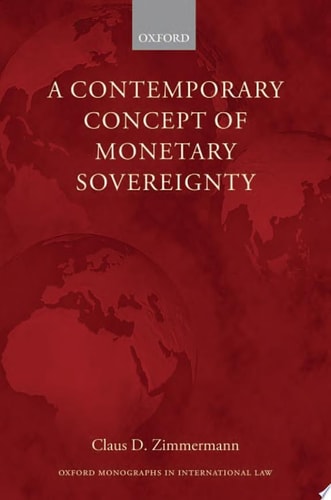
Contemporary Concept of Monetary Sovereignty
0
0
As an Amazon Associate and affiliate partner, Menrva Books earns from qualifying purchases. Learn more
Author Description
Monetary Sovereignty Is A Crucial Legal Concept Dictating That States Have Sovereignty Over Their Own Monetary, Financial, And Fiscal Affairs. However, It Does Not Feature As Part Of Any Key Instruments Of International Law, Including The Articles Of Agreement Of The International Monetary Fund. Rather, It Has Remained A Somewhat Separate Notion, Developed Under Contemporary International Law From An Assertion Of The Former Permanent Court Of International Justice In 1929. As A Consequence Of Globalization And Increasing Financial Integration And A Worldwide Trend Towards The Creation Of Economic And Monetary Unions, The Principle Of Monetary Sovereignty Has Undergone Significant Change. This Book Examines This Evolution In Detail, And Provides A Conceptual Framework To Demonstrate What This Means For The Legal And Economic Challenges Faced By The International Community. The Book Examines The Historic Origins And Evolution Of The Concept Of Monetary Sovereignty, Putting It Into The Context Of Broader Concepts Of Sovereignty. It Argues That Monetary Sovereignty Remains Relevant As A Dynamic Legal Concept With Both Positive And Normative Components. It Investigates The Continuing Hybridization Of International Monetary Law Resulting From Changes To Its Formal And Material Sources. It Then Examines The Complex Phenomenon Of Exchange Rate Misalignment Under International Monetary And Trade Law, And The Increasing Regionalization Of Monetary Sovereignty, Notably In Light Of The European Sovereign Debt Crisis. Finally, It Assesses The Role The Concept Of Monetary Sovereignty Can Play In The Reorganization Of International Finance Following The Recent Global Financial Crisis.
Menrva's Summary
THE THESIS
This book investigates the evolving legal and economic definition of monetary sovereignty in the context of globalization and international financial integration. Claus D. Zimmermann, a legal scholar, utilizes historical analysis and contemporary case studies to argue that monetary sovereignty persists as a dynamic legal concept. He provides a framework to address how states balance domestic fiscal control against the pressures of international monetary law and regional economic unions.
THE SCOPE MAP
What You Will Find
- Historical origins of monetary sovereignty from the 1929 Permanent Court of International Justice ruling
- Analysis of the hybridization of international monetary law sources
- Examination of exchange rate misalignment under trade and monetary law
- Assessment of regionalization trends, specifically the European sovereign debt crisis
Scope Limits
- Does not provide a comprehensive guide to domestic banking regulations
- Does not cover non-state digital currency policy in depth
THE AUTHORITY PERSPECTIVE
Experts identify this work as a rigorous legal analysis of the intersection between state sovereignty and global financial governance. Readers frequently note the academic density of the prose, making it a specialized resource for students and practitioners of international law.
Page Count:
292
Publication Date:
2013-01-01
Publisher:
Oxford University Press
ISBN-10:
0191502057
ISBN-13:
9780191502057
Economics
International relations
Finance
Law
Community Tags
Similar Books