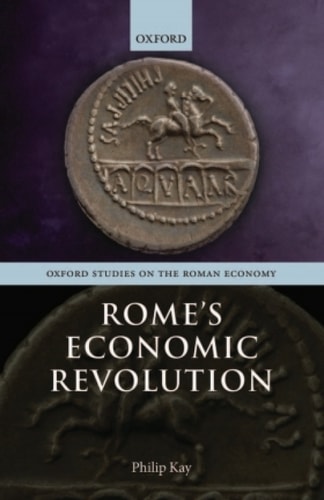
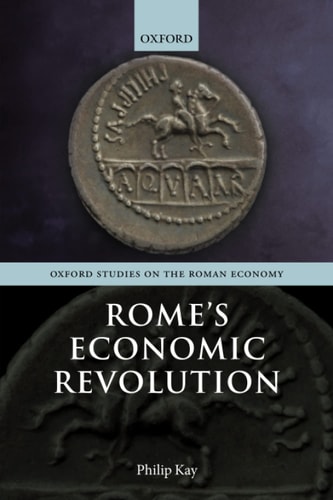
Rome's Economic Revolution
0
0
As an Amazon Associate and affiliate partner, Menrva Books earns from qualifying purchases. Learn more
Author Description
In this volume, Philip Kay examines economic change in Rome and Italy between the Second Punic War and the middle of the first century BC. He argues that increased inflows of bullion, in particular silver, combined with an expansion of the availability of credit to produce significant growth in monetary liquidity. This, in turn, stimulated market developments, such as investment farming, trade, construction, and manufacturing, and radically changed the composition and scale of the Roman economy. Using a wide range of evidence and scholarly investigation, Kay demonstrates how Rome, in the second and first centuries BC, became a coherent economic entity experiencing real per capita economic growth. Without an understanding of this economic revolution, the contemporaneous political and cultural changes in Roman society cannot be fully comprehended or explained.
Menrva's Summary
THE THESIS
This volume investigates the mechanisms behind the significant economic growth and structural transformation of Rome and Italy between the Second Punic War and the mid-first century BC. Philip Kay, a specialist in Roman economic history, utilizes a synthesis of numismatic data, literary sources, and archaeological evidence to argue that an influx of bullion and the expansion of credit markets catalyzed a period of sustained monetary liquidity. This framework posits that the resulting economic shift was a prerequisite for the political and cultural developments that defined the late Roman Republic.
THE SCOPE MAP
What You Will Find
- Analysis of bullion inflows and silver supply in the Roman Republic
- Examination of credit availability and its impact on monetary liquidity
- Investigation into market sectors including investment farming, trade, and construction
- Evaluation of per capita economic growth metrics
Scope Limits
- The study is geographically focused on Rome and Italy
- The chronological scope is strictly limited to the period between the Second Punic War and the mid-first century BC
THE AUTHORITY PERSPECTIVE
Scholars recognize this work as a significant contribution to the study of Roman economic history, particularly for its focus on the intersection of monetary policy and market expansion. Readers frequently note the academic density of the prose, which serves as a foundational text for those researching the economic underpinnings of the late Republic.
Page Count:
400
Publication Date:
2014-01-01
Publisher:
OUP Oxford
ISBN-10:
0191507350
ISBN-13:
9780191507359
Economics
History
Ancient - Rome
Economic History
Ancient History
Community Tags
Other Editions(3)

Similar Books