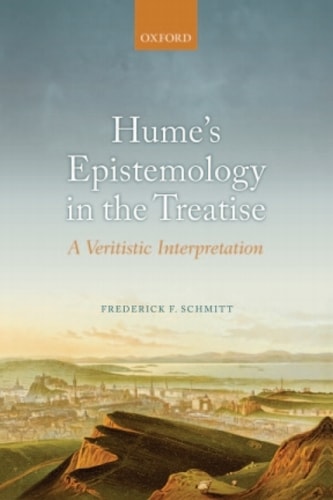
Hume's Epistemology in the Treatise: A Veritistic Interpretation
0
0
As an Amazon Associate and affiliate partner, Menrva Books earns from qualifying purchases. Learn more
Author Description
Frederick F. Schmitt offers a systematic interpretation of David Hume's epistemology, as it is presented in the indispensable A Treatise of Human Nature. Hume's text alternately manifests scepticism, empiricism, and naturalism in epistemology. Interpretations of his epistemology have tended to emphasise one of these apparently conflicting positions over the others. But Schmitt argues that the positions can be reconciled by tracing them to a single underlying epistemology of knowledge and probability quietly at work in the text, an epistemology according to which truth is the chief cognitive merit of a belief, and knowledge and probable belief are species of reliable belief. Hume adopts Locke's dichotomy between knowledge and probability and reassigns causal inference from its traditional place in knowledge to the domain of probability--his most significant departure from earlier accounts of cognition. This shift of causal inference to an associative and imaginative operation raises doubts about the merit of causal inference, suggesting the counterintuitive consequence that causal inference is wholly inferior to knowledge-producing demonstration. To defend his associationist psychology of causal inference from this suggestion, Hume must favourably compare causal inference with demonstration in a manner compatible with associationism. He does this by finding an epistemic status shared by demonstrative knowledge and causally inferred beliefs--the status of justified belief. On the interpretation developed here, he identifies knowledge with infallible belief and justified belief with reliable belief, i.e., belief produced by truth-conducive belief-forming operations. Since infallibility implies reliable belief, knowledge implies justified belief. He then argues that causally inferred beliefs are reliable, so share this status with knowledge. Indeed Hume assumes that causally inferred beliefs enjoy this status in his very argument for associationism.
Menrva's Summary
THE THESIS
Can David Hume's seemingly contradictory epistemological stances—skepticism, empiricism, and naturalism—be reconciled through a unified theory of knowledge and probability? Frederick F. Schmitt, a scholar of epistemology, provides a systematic re-evaluation of Hume's A Treatise of Human Nature. He argues that Hume employs a consistent underlying framework where truth serves as the primary cognitive merit, and both knowledge and probable belief are categorized as forms of reliable belief. By analyzing Hume's departure from Lockean traditions, Schmitt demonstrates how causal inference is reclassified as an associative operation while maintaining its status as a justified, reliable belief-forming process.
THE SCOPE MAP
What You Will Find
- A detailed analysis of the dichotomy between knowledge and probability in Hume's work.
- A veritistic interpretation of Hume's associationist psychology.
- An examination of the relationship between infallible belief and reliable belief-forming operations.
Scope Limits
- The analysis is strictly confined to the epistemological arguments presented within A Treatise of Human Nature.
- The text does not provide a comprehensive biography of Hume or an exhaustive survey of his later political or religious writings.
THE AUTHORITY PERSPECTIVE
Scholars frequently cite this work as a rigorous attempt to resolve long-standing tensions in Humean scholarship through the lens of veritistic epistemology. Experts highlight the book's technical precision in addressing the mechanics of causal inference and its value as a specialized resource for advanced students of early modern philosophy.
Page Count:
448
Publication Date:
2014-01-01
Publisher:
OUP Oxford
ISBN-10:
0191505617
ISBN-13:
9780191505614
Philosophy
Empiricism
History & Surveys
Knowledge Theory
Philosophy history
David Hume
Epistemology
Community Tags
Other Editions(2)

Similar Books


Reader Comments
Share Your Thoughts
No comments yet. Be the first to share your thoughts!