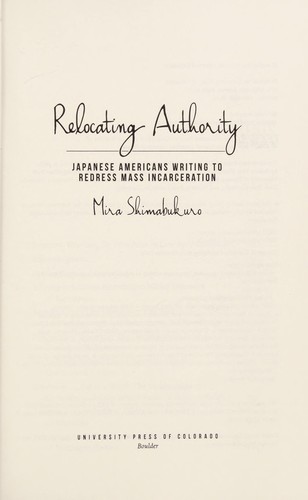
Relocating Authority
0
0
As an Amazon Associate and affiliate partner, Menrva Books earns from qualifying purchases. Learn more
Author Description
"Relocating Authority examines the ways Japanese Americans have continually used writing to respond to the circumstances of their community's mass imprisonment during World War II. Using both Nikkei cultural frameworks and community-specific history for methodological inspiration and guidance, Mira Shimabukuro shows how writing was used privately and publicly to individually survive and collectively resist the conditions of incarceration. Examining a wide range of diverse texts and literacy practices such as diary entries, note-taking, manifestos, and multiple drafts of single documents, Relocating Authority draws upon community archives, visual histories, and Asian American history and theory to reveal the ways writing has served as a critical tool for incarcerees and their descendants. Incarcerees not only used writing to redress the 'internment' in the moment but also created pieces of text that enabled and inspired further redress long after the camps had closed. Relocating Authority highlights literacy's enduring potential to participate in social change and assist an imprisoned people in relocating authority away from their captors and back to their community and themselves. It will be of great interest to students and scholars of ethnic and Asian American rhetorics, American studies, and anyone interested in the relationship between literacy and social justice"
Menrva's Summary
THE THESIS
This book investigates how Japanese Americans utilized writing as a means of survival and resistance during their mass imprisonment in World War II. Mira Shimabukuro, drawing on Nikkei cultural frameworks and community history, demonstrates how private and public writing practices allowed individuals to endure and collectively oppose the conditions of incarceration. The study analyzes diverse texts, including diary entries, notes, and multiple drafts, sourced from community archives and visual histories. It argues that these written works not only addressed the injustices of internment in the moment but also inspired subsequent efforts for redress, highlighting literacy's role in social change and the reclamation of authority by the imprisoned community.
THE SCOPE MAP
- Analysis of writing as a tool for survival and resistance during Japanese American incarceration.
- Application of Nikkei cultural frameworks and community-specific history.
- Examination of private and public writing practices.
- Inclusion of diverse texts: diary entries, note-taking, manifestos, multiple drafts.
- Utilization of community archives, visual histories, and Asian American history and theory.
- Exploration of how writing enabled ongoing redress beyond the camp closures.
- Highlighting literacy's potential for social change and community empowerment.
THE AUTHORITY PERSPECTIVE
The book is of significant interest to students and scholars in ethnic and Asian American rhetorics, American studies, and those concerned with the intersection of literacy and social justice. It is recognized for its in-depth examination of how writing served as a critical tool for incarcerees and their descendants. The work is noted for its methodological inspiration drawn from both Nikkei cultural frameworks and community-specific history. By analyzing a wide range of texts and literacy practices, the book reveals the enduring potential of literacy to foster social change and empower marginalized communities.
Page Count:
0
Publication Date:
2015-01-01
ISBN-10:
1607324016
ISBN-13:
9781607324010
Art
Non-Fiction
Science
Western
History
Rhetoric
Literacy Studies
Social justice
Community Tags
Similar Books