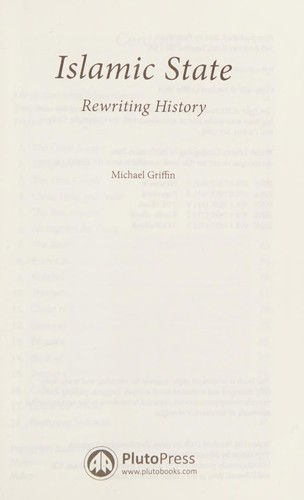
Islamic State
0
0
As an Amazon Associate and affiliate partner, Menrva Books earns from qualifying purchases. Learn more
Author Description
The world is watching Islamic State's lightning advance through Syria to the gates of Baghdad. For the third time in fifteen years, the US risks being drawn into another war in the Middle East despite its experiences in Afghanistan and Iraq. IS are creating catastrophic waves across the region, but it is still unclear what lies behind its success. Islamic State: Breaking the Walls takes the long-view by analysing IS's beginnings in Iraq to their involvement in the Arab Spring and through to the present day. It discusses the myriad of regional players engaged in a seemingly endless power game: Saudi Arabia, Qatar, Turkey and Iraq have all contributed to the success of IS by supplying arms and funds. Using a fast-paced, narrative-driven style, Michael Griffin foregrounds the story of the uprising against President Assad of Syria and describes his regime's varied responses; the human cost; the role played by Free Syrian Army, Islamist groups, Iran, Hezbollah and Russia; the chemical weapons attacks in 2013; and the House of Commons vote not to impose a no-fly zone over the country.
Menrva's Summary
THE THESIS
The rise of the Islamic State presents a critical geopolitical challenge, prompting renewed US involvement in the Middle East despite prior conflicts. Michael J. Griffin's analysis traces the group's origins from its inception in Iraq through its involvement in the Arab Spring to its current territorial gains. The book examines the complex web of regional actors, including Saudi Arabia, Qatar, Turkey, and Iraq, whose financial and military support has inadvertently fueled IS's success. Griffin details the Syrian uprising against President Assad, the human toll of the conflict, and the involvement of various factions like the Free Syrian Army, Islamist groups, Iran, and Hezbollah, alongside Russia's role and the controversial chemical weapons attacks of 2013.
THE SCOPE MAP
- Analysis of the Islamic State's origins and evolution in Iraq.
- Examination of IS's role and impact during the Arab Spring.
- Discussion of regional players' contributions to IS's success (Saudi Arabia, Qatar, Turkey, Iraq).
- Detailed account of the uprising against President Assad in Syria.
- Exploration of the human cost and varied responses to the Syrian conflict.
- Role of the Free Syrian Army, Islamist groups, Iran, and Hezbollah.
- Inclusion of the 2013 chemical weapons attacks.
- Contextualization of the UK House of Commons vote on a no-fly zone.
THE AUTHORITY PERSPECTIVE
Michael J. Griffin's "Islamic State: Breaking the Walls" offers a comprehensive historical and political analysis of the group's rise, tracing its trajectory from Iraq to its impact on the Syrian conflict and broader Middle Eastern power dynamics. The book is noted for its detailed examination of the regional players and their complicity in the group's expansion, as well as its narrative-driven approach to complex geopolitical events. It provides context for understanding the current crisis by foregrounding the human cost and the intricate involvement of various state and non-state actors. The work serves as a timely and informative resource for those seeking to comprehend the multifaceted origins and ongoing consequences of the Islamic State's presence.
Page Count:
176
Publication Date:
2016-01-01
ISBN-10:
0745336515
ISBN-13:
9780745336510
Non-Fiction
History
Politics
Current Events
Community Tags
Similar Books