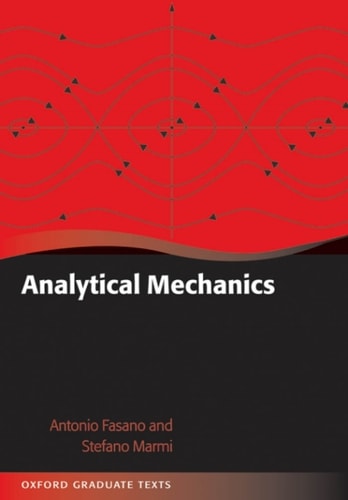
Analytical Mechanics: An Introduction
0
0
As an Amazon Associate and affiliate partner, Menrva Books earns from qualifying purchases. Learn more
Author Description
Analytical Mechanics is the investigation of motion with the rigorous tools of mathematics. Rooted in the works of Lagrange, Euler, Poincaré (to mention just a few), it is a very classical subject with fascinating developments and still rich of open problems. It addresses such fundamental questions as: Is the solar system stable? Is there a unifying 'economy' principle in mechanics? How can a point mass be described as a 'wave'? And has remarkable applications to many branches of physics (Astronomy, Statistical Mechanics, Quantum Mechanics). This book was written to fill a gap between elementary expositions and more advanced (and clearly more stimulating) material. It takes up the challenge to explain the most relevant ideas (generally highly non-trivial) and to show the most important applications using a plain language and 'simple' mathematics, often through an original approach. Basic calculus is enough for the reader to proceed through the book. New mathematical concepts are fully introduced and illustrated in a simple, student-friendly language. More advanced chapters can be omitted while still following the main ideas. Anybody wishing to go deeper in some direction will find at least the flavour of recent developments and many bibliographical references. The theory is always accompanied by examples. Many problems are suggested and some are completely worked out at the end of each chapter. The book may effectively be used (and has been used at several Italian Universities) for undergraduate as well as for PhD courses in Physics and Mathematics at various levels.
Menrva's Summary
THE THESIS
This text investigates the fundamental principles of motion through the rigorous application of mathematical frameworks. Authors Antonio Fasano and Stefano Marmi, both experienced academics, bridge the gap between elementary physics expositions and advanced research-level material. By utilizing a pedagogical approach that requires only basic calculus, the authors present classical mechanics as a dynamic field with ongoing relevance to modern physics, including statistical and quantum mechanics.
THE SCOPE MAP
What You Will Find
- Mathematical foundations of Lagrangian and Hamiltonian mechanics
- Applications to celestial mechanics and the stability of the solar system
- Integration of statistical and quantum mechanical concepts
- Worked examples and problem sets at the end of each chapter
Scope Limits
- Does not provide an exhaustive treatment of relativistic mechanics
- Does not serve as a primary reference for pure mathematical physics research
THE AUTHORITY PERSPECTIVE
Experts and educators frequently highlight this text as a bridge between undergraduate and graduate-level study due to its accessible yet rigorous presentation. Readers often note that the inclusion of worked examples and bibliographical references makes it a practical resource for both self-study and formal university coursework.
Page Count:
792
Publication Date:
2006-01-01
Publisher:
OUP Oxford
ISBN-10:
0191513598
ISBN-13:
9780191513596
Mathematics - General
Academic
Earth Sciences
textbook
Physics
Mathematics
Mathematics Statistics
Classical Mechanics
Analytical Mechanics
Community Tags
Similar Books