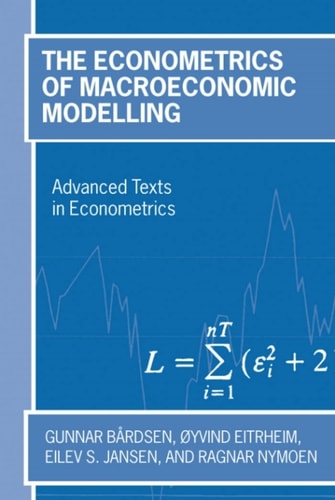
The Econometrics of Macroeconomic Modelling
0
0
As an Amazon Associate and affiliate partner, Menrva Books earns from qualifying purchases. Learn more
Author Description
Macroeconometric models, in many ways the flagships of the economist's profession in the 1960s, came under increasing attack from both theoretical economist and practitioners in the late 1970s. Critics referred to their lack of microeconomic theoretical foundations, ad hoc models of expectations, lack of identification, neglect of dynamics and non-stationarity, and poor forecasting properties. By the start of the 1990s, the status of macroeconometric models had declined markedly, and had fallen completely out of, and with, academic economics. Nevertheless, unlike the dinosaurs to which they often have been likened, macroeconometric models have never completely disappeared from the scene. This book describes how and why the discipline of macroeconometric modelling continues to play a role for economic policymaking by adapting to changing demands, in response, for instance, to new policy regimes like inflation targeting. Model builders have adopted new insights from economic theory and taken advantage of the methodological and conceptual advances within time series econometrics over the last twenty years. The modelling of wages and prices takes a central part in the book as the authors interpret and evaluate the last forty years of international research experience in the light of the Norwegian 'main course' model of inflation in a small open economy. The preferred model is a dynamic model of incomplete competition, which is evaluated against alternatives as diverse as the Phillips curve, Nickell-Layard wage curves, the New Keynesian Phillips curve, and monetary inflation models on data from the Euro area, the UK, and Norway. The wage price core model is built into a small econometric model for Norway to analyse the transmission mechanism and to evaluate monetary policy rules. The final chapter explores the main sources of forecast failure likely to occur in a practical modelling situation, using the large-scale nodel RIMINI and the inflation models of earlier chapter
Menrva's Summary
THE THESIS
This text investigates how macroeconometric modelling has evolved to maintain its relevance in economic policymaking despite significant theoretical and practical challenges encountered since the 1970s. The authors, a team of experienced economists, utilize a framework grounded in time series econometrics and dynamic modelling to address the criticisms of early macroeconometric models. By integrating microeconomic foundations and modern methodological advances, they demonstrate how these models adapt to contemporary policy regimes such as inflation targeting.
THE SCOPE MAP
What You Will Find
- Analysis of the Norwegian 'main course' model of inflation.
- Evaluation of wage and price modelling within small open economies.
- Comparative study of the Phillips curve, Nickell-Layard wage curves, and New Keynesian models.
- Practical application of models using data from the Euro area, the UK, and Norway.
Scope Limits
- The text focuses primarily on the wage-price core and specific inflation-targeting frameworks.
- It does not provide an exhaustive history of all global macroeconometric developments outside the specified regional contexts.
THE AUTHORITY PERSPECTIVE
Experts recognize this work as a rigorous technical resource for understanding the transition from traditional macroeconometric models to modern dynamic frameworks. Readers frequently note the high level of mathematical and statistical density required to fully engage with the authors' empirical evaluations.
Page Count:
360
Publication Date:
2005-01-01
Publisher:
Oxford University Press
ISBN-10:
0191529877
ISBN-13:
9780191529870
Economics
Macroeconomics
Academic
Quantitative Methods
Econometrics
Community Tags
Similar Books



Reader Comments
Share Your Thoughts
No comments yet. Be the first to share your thoughts!