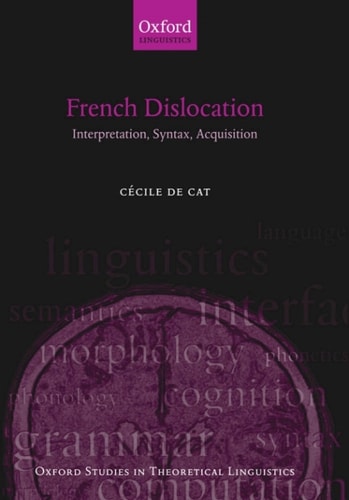
French Dislocation: Interpretation, Syntax, Acquisition
0
0
As an Amazon Associate and affiliate partner, Menrva Books earns from qualifying purchases. Learn more
Author Description
The pervasive use of dislocations (as in Le chocolat, c'est bon) is a key characteristic of spoken French. This book offers various new and well-motivated insights, based on tests conducted by the author, on the syntactic analysis, prosody, and the interpretation of dislocation in spoken French. It also considers important aspects of the acquisition of dislocation by monolingual children learning different French dialects. The author argues that spoken French is a discourse-configurational language, in which topics are obligatorily dislocated. She develops a syntactically parsimonious account, which maximizes the import of interfaces involved with discourse and prosody. She proposes clear diagnostics, following a reexamination of the status of subject clitics and a reevaluation of the characteristic prosody of dislocated constituents. The theoretical arguments throughout the book rest on data that comes from corpora of spontaneous production and from various elitication experiments. This book throws new light on French syntax and prosody and makes an important and original contribution to the study of linguistic interfaces. Clearly expressed and tightly argued it will interest scholars and advanced students of French and of its acquisition as a first language as well as linguistic theorists interested in the interfaces between syntax, discourse, and phonology.
Menrva's Summary
THE THESIS
This book investigates the syntactic, prosodic, and acquisitional properties of dislocation in spoken French to determine if the language functions as a discourse-configurational system. Cécile de Cat, a specialist in French linguistics, utilizes data from spontaneous speech corpora and elicitation experiments to construct her argument. She proposes that spoken French requires the dislocation of topics, presenting a parsimonious syntactic framework that emphasizes the interaction between discourse and prosody. By reevaluating subject clitics and prosodic patterns, the author provides a comprehensive model for understanding this pervasive linguistic phenomenon.
THE SCOPE MAP
What You Will Find
- Analysis of dislocation structures in spoken French
- Examination of the interface between syntax, discourse, and prosody
- Longitudinal data on the acquisition of dislocation by monolingual children
- Reevaluation of subject clitics and their role in sentence structure
Scope Limits
- Does not cover written French syntax or formal literary registers
- Does not provide a comparative analysis of non-Romance language dislocation patterns
THE AUTHORITY PERSPECTIVE
Scholars and advanced students of linguistics frequently cite this work as a foundational text for understanding the interface between syntax and discourse in French. Experts note the academic density of the prose, which is tailored specifically for researchers in theoretical linguistics and language acquisition.
Page Count:
288
Publication Date:
2007-01-01
Publisher:
OUP Oxford
ISBN-10:
0191528137
ISBN-13:
9780191528132
English & College Success
Phonology
English
French language
Syntax
Linguistics
Theoretical Linguistics
Community Tags
Other Editions(3)
Similar Books