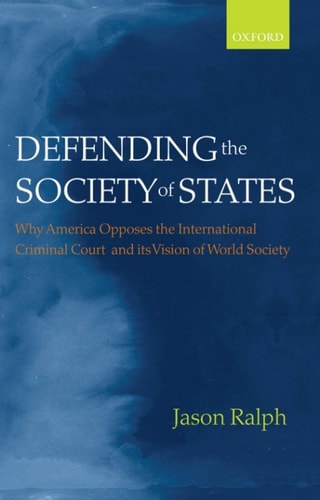
Defending the Society of States: Why America Opposes the International Criminal Court and its Vision of World Society
0
0
As an Amazon Associate and affiliate partner, Menrva Books earns from qualifying purchases. Learn more
Author Description
This book is among the first to address the issues raised by the International Criminal Court (ICC) from an International Relations perspective. By clearly outlining a theoretical framework to interpret these issues, Ralph makes a significant contribution to the English School's study of international society. More specifically, he offers a concise definition of 'world society' and thus helps to resolve a longstanding problem in international theory. This groundbreaking conceptual work is supported by an in-depth empirical analysis of American opposition to the ICC. Ralph goes beyond the familiar arguments related to national interests and argues that the Court has exposed the extent to which American notions of accountability are tied to the nation-state. Where other democracies are willing to renegotiate their social contract because they see themselves as part of world society, the US protects its particular contract with 'the people' because it offers a means of distinguishing America and its democracy from the rest of the world. This 'sovereigntist', or more accurately 'Americanist', influence is further illustrated in chapters on the sources of law, universal jurisdiction, transatlantic relations and US policy on international humanitarian law in the war on terror. The book concludes by evoking E.H. Carr's criticism of those great powers who claim that a harmony exists between their particular interests and those of wider society. It also recalls his argument that great powers sometimes need to compromise and in this context, Ralph argues that support for the ICC is a more effective means of fulfilling America's purpose and a less costly sacrifice than that demanded by the 'Americanist' policy of nation-building.
Menrva's Summary
THE THESIS
This book investigates the theoretical and political reasons behind the United States' persistent opposition to the International Criminal Court (ICC) through the lens of the English School of international relations. Jason Ralph, a scholar of international politics, utilizes a framework rooted in the concept of 'world society' to analyze how American notions of accountability remain tethered to the nation-state. He argues that the US resistance to the ICC is not merely a matter of national interest, but a reflection of a distinct 'Americanist' ideology that prioritizes the domestic social contract over global legal integration.
THE SCOPE MAP
What You Will Find
- A theoretical redefinition of 'world society' within international relations theory.
- Empirical analysis of US policy regarding universal jurisdiction and international humanitarian law.
- Examination of transatlantic diplomatic tensions concerning the ICC.
- Application of E.H. Carr's critiques of great power politics to contemporary American foreign policy.
Scope Limits
- The text does not provide a comprehensive legal history of the ICC's founding statutes.
- It does not focus on the internal judicial procedures of the Court itself, but rather on the political reactions of the US government.
THE AUTHORITY PERSPECTIVE
Scholars in the field of international relations recognize this work as a significant contribution to the English School's theoretical literature. Experts frequently note the academic density of the prose, which serves as a foundational text for understanding the intersection of American sovereignty and global legal institutions.
Page Count:
264
Publication Date:
2007-01-01
Publisher:
Oxford University Press
ISBN-10:
0191526789
ISBN-13:
9780191526787
International Law
United States
International relations
Foreign Policy
Community Tags
Similar Books