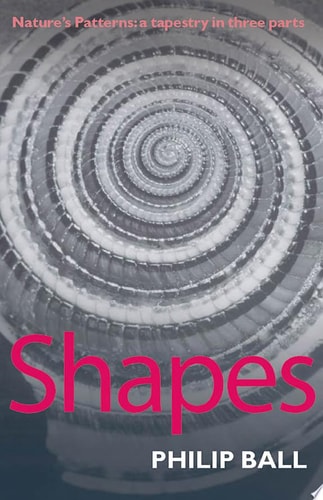
Shapes
0
0
As an Amazon Associate and affiliate partner, Menrva Books earns from qualifying purchases. Learn more
Author Description
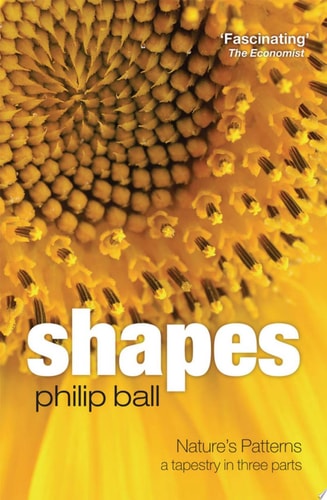
Patterns Are Everywhere In Nature - In The Ranks Of Clouds In The Sky, The Stripes Of An Angelfish, The Arrangement Of Petals In Flowers. Where Does This Order And Regularity Come From? It Creates Itself. The Patterns We See Come From Self-organization. Whether Living Or Non-living, Scientists Have Found That There Is A Pattern-forming Tendency Inherent In The Basic Structure And Processes Of Nature, So That From A Few Simple Themes, And The Repetition Of Simple Rules, Endless Beautiful Variations Can Arise. Part Of A Trilogy Of Books Exploring The Science Of Patterns In Nature, Acclaimed Science Writer Philip Ball Here Looks At How Shapes Form. From Soap Bubbles To Honeycombs, Delicate Shell Patterns, And Even The Developing Body Parts Of A Complex Animal Like Ourselves, He Uncovers Patterns In Growth And Form In All Corners Of The Natural World, Explains How These Patterns Are Self-made, And Why Similar Shapes And Structures May Be Found In Very Different Settings, Orchestrated By Nothing More Than Simple Physical Forces. This Book Will Make You Look At The World With Fresh Eyes, Seeing Order And Form Even In The Places You'd Least Expect.
Menrva's Summary
THE THESIS
What are the underlying physical mechanisms that drive the emergence of complex shapes and patterns in both living and non-living systems? Philip Ball, a veteran science writer, synthesizes research from physics, biology, and mathematics to argue that self-organization is the primary architect of natural form. By examining how simple physical forces and repetitive rules govern growth, he demonstrates that the complexity observed in nature arises from fundamental, predictable processes rather than external design.
THE SCOPE MAP
What You Will Find
- Analysis of self-organization in biological and physical systems
- Examination of pattern formation in soap bubbles, honeycombs, and shells
- Discussion of developmental biology and morphogenesis
- Exploration of how simple physical forces create complex structures
Scope Limits
- Does not provide a comprehensive mathematical derivation for every phenomenon discussed
- Focuses primarily on physical and biological patterns rather than abstract geometric theory
THE AUTHORITY PERSPECTIVE
Experts and readers alike praise this work for its ability to translate complex scientific concepts into accessible, engaging prose. It is widely regarded as a foundational text for those interested in the intersection of physics and natural history.
Page Count:
320
Publication Date:
2009-01-01
Publisher:
Oup Oxford
ISBN-10:
0191528730
ISBN-13:
9780191528736
Nature
Science
Popular Science
Mathematics
Biology
Physics
Community Tags
Similar Books