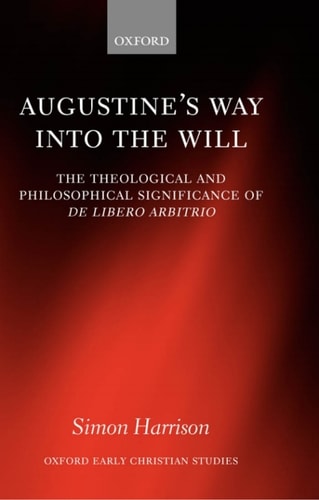
Augustine's Way into the Will: The Theological and Philosophical Significance of De libero arbitrio
0
0
As an Amazon Associate and affiliate partner, Menrva Books earns from qualifying purchases. Learn more
Author Description
Augustine's dialogue De libero arbitrio (On Free Choice) is, with his Confessions and City of God, one of his most important and widely read works. It contains one of the earliest accounts of the concept of 'free will' in the history of philosophy. Composed during a key period in Augustine's early career, between his conversion to Christianity and his ordination as a bishop, it has often been viewed as a an incoherent mixture of his 'early' and 'late' thinking. Simon Harrison offers an original account of Augustine's theory of will, taking seriously both the philosophical arguments and literary form of the text. Relating De libero arbitrio to other key texts of Augustine's, in particular the City of God and the Confessions, Harrison shows that Augustine approaches the problem of free will as a problem of knowledge: how do I know that I am free?, and that Augustine uses the dialogue form to instantiate his 'way into the will'.
Menrva's Summary
THE THESIS
*This work investigates how Augustine’s dialogue De libero arbitrio functions as a coherent philosophical and theological project rather than a disjointed collection of early and late ideas.* Simon Harrison, a scholar of early Christian thought, utilizes a close reading of Augustine’s primary texts to argue that the author treats the problem of free will primarily as an epistemological challenge. By examining the dialogue form itself, Harrison demonstrates that Augustine intends for the reader to experience the process of discovering their own freedom through the text's structure.
THE SCOPE MAP
What You Will Find
- A detailed analysis of De libero arbitrio in relation to Confessions and City of God.
- An examination of the dialogue form as a pedagogical and philosophical tool.
- A re-evaluation of the 'early' versus 'late' Augustine dichotomy.
Scope Limits
- The study does not provide a comprehensive biography of Augustine.
- The text does not cover the entirety of Augustine’s later anti-Pelagian writings in depth.
THE AUTHORITY PERSPECTIVE
Scholars recognize this text as a significant contribution to Augustinian studies, particularly for its focus on the literary form of the dialogue. Readers frequently note the academic density of the prose, which is intended for those already familiar with the primary source material.
Page Count:
208
Publication Date:
2006-01-01
Publisher:
Oxford University Press
ISBN-10:
0191520667
ISBN-13:
9780191520662
Philosophy
Religion
Philosophy history
Theology
Metaphysics
Community Tags
Other Editions(2)

Similar Books