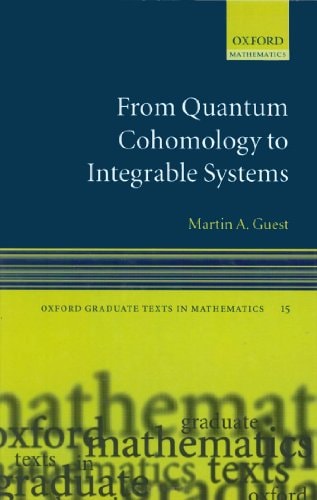
From Quantum Cohomology to Integrable Systems
0
0
As an Amazon Associate and affiliate partner, Menrva Books earns from qualifying purchases. Learn more
Author Description
Quantum Cohomology Has Its Origins In Symplectic Geometry And Algebraic Geometry, But Is Deeply Related To Differential Equations And Integrable Systems. This Text Explains What Is Behind The Extraordinary Success Of Quantum Cohomology, Leading To Its Connections With Many Existing Areas Of Mathematics As Well As Its Appearance In New Areas Such As Mirror Symmetry. Certain Kinds Of Differential Equations (or D-modules) Provide The Key Links Between Quantum Cohomology And Traditional Mathematics; These Links Are The Main Focus Of The Book, And Quantum Cohomology And Other Integrable Pdes Such As The Kdv Equation And The Harmonic Map Equation Are Discussed Within This Unified Framework. Aimed At Graduate Students In Mathematics Who Want To Learn About Quantum Cohomology In A Broad Context, And Theoretical Physicists Who Are Interested In The Mathematical Setting, The Text Assumes Basic Familiarity With Differential Equations And Cohomology.
Menrva's Summary
THE THESIS
This text investigates the mathematical foundations and interdisciplinary connections between quantum cohomology and the theory of integrable systems. Martin A. Guest, a specialist in differential geometry and integrable systems, synthesizes complex concepts from symplectic and algebraic geometry to demonstrate how specific differential equations serve as the bridge between these fields. The book provides a unified framework for understanding how quantum cohomology relates to classical integrable partial differential equations, such as the KdV and harmonic map equations.
THE SCOPE MAP
What You Will Find
- Theoretical framework linking quantum cohomology to D-modules and integrable systems
- Analysis of the KdV equation and harmonic map equations within a geometric context
- Mathematical foundations of mirror symmetry as it pertains to quantum cohomology
Scope Limits
- The text assumes prior graduate-level familiarity with differential equations and cohomology
- It does not serve as an introductory primer for undergraduate-level geometry
THE AUTHORITY PERSPECTIVE
Experts and graduate students frequently cite this work as a foundational resource for bridging the gap between algebraic geometry and theoretical physics. Readers note the high level of technical density, which requires a strong background in differential geometry to fully grasp the presented proofs and derivations.
Page Count:
328
Publication Date:
2008-01-01
Publisher:
OUP Oxford
ISBN-10:
0191524123
ISBN-13:
9780191524127
Mathematics
Kindle Store
Algebraic Geometry
Geometry
Mathematical Physics
Symplectic Geometry
Categories
Kindle eBooks
Community Tags
Other Editions(3)

Similar Books